Post-Exposure Bake (PEB)
A post-exposure bake (PEB) is the step of heating the wafer on a hot plate at a fixed temperature for a fixed time after the photoresist is exposed and before it is developed. In chemically amplified resists, the heat lets the acid created by exposure move and drive the deprotection reaction, which is what makes exposed areas soluble.
Also called: PEB
Diagram
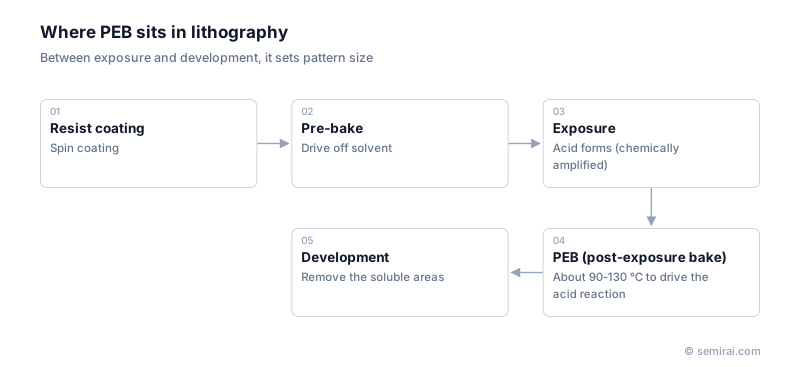
Why PEB controls pattern size
Typical conditions are roughly 90-130 °C for about 60-90 seconds, depending on the resist. A higher temperature or longer time lets the acid travel further and the reaction proceed further. Too much reaction spreads acid into unexposed areas and blurs the edge; too little leaves the pattern incompletely formed.
Along with exposure dose, PEB is one of the steps that most strongly determines critical dimensions. Even a fraction of a degree changes linewidth, so the in-plane temperature uniformity of PEB hot plates is controlled very tightly.
PEB for non-amplified resists and in the track
Conventional novolac resists are sometimes baked after exposure too, for a different reason. Standing waves, formed by interference between incident and reflected light, leave ripples on the resist sidewall; the bake lets components of the resist diffuse slightly and smooth them out.
PEB takes place in the coater/developer track, which is linked directly to the exposure tool. The delay between exposure and PEB is also controlled strictly, because acid in the film can be neutralised or diffuse while the wafer waits.
Japanese companies involved
- Tokyo Electron and SCREEN Holdings make the coater/developer tracks whose PEB hot plates are linked in-line with exposure tools.
- Tokyo Electron (TEL) · Coat/develop, etch and deposition equipment
- SCREEN Holdings · Wafer cleaning, coat/develop and inspection equipment
FAQ
How does PEB differ from a pre-bake?
The pre-bake, or soft bake, comes right after coating and before exposure; it drives solvent out of the resist and stabilises the film. PEB comes after exposure and before development and drives the acid-catalysed chemistry. They differ in timing, purpose and usually in temperature.
What happens if PEB temperature is non-uniform?
The acid travels different distances in different places, so linewidth varies across the wafer in a pattern that mirrors the hot plate's temperature map. That is why PEB plates have multiple heating zones and are calibrated with temperature-sensing wafers.
Related pages
Sources
Last updated: November 12, 2026