Manufacturing Execution System (MES)
A manufacturing execution system (MES) is the software that runs the shop floor of a wafer fab: it tracks each lot through hundreds of process steps, decides what each tool should run, sends recipes, and records process, measurement and defect data. It sits between business planning systems and the tools and automated transport.
Also called: MES
Diagram
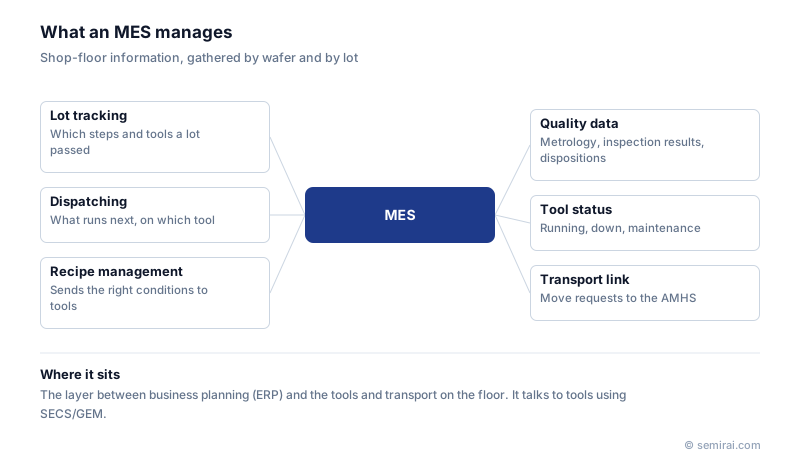
What an MES does
The core job is lot tracking. The MES knows which step every lot has reached, which tool processed it, with which recipe, and what the measurements showed. From this it dispatches work: when a tool becomes free, it decides which waiting lot goes next, taking priorities and time limits between steps into account.
It also manages recipes, holds lots that fail inspection, links with statistical process control (SPC) and advanced process control (APC) systems, and tracks tool states such as running, idle and down. These records give engineers the genealogy they need to trace a yield problem back to a tool or a step.
How it connects to tools and transport
Above the MES is enterprise resource planning (ERP), which handles orders and finance. Below it, tools talk to the factory host through the SEMI SECS/GEM standards, and the automated material handling system (AMHS) moves FOUPs on request. Further SEMI standards such as E84 (carrier hand-off at the load port) and E87 (carrier management) let the MES, tools and transport work together.
Modern fabs feed MES data into large analytics platforms to find yield excursions early and to schedule maintenance, but the MES itself remains the system of record for what happened to each wafer.
Japanese companies involved
- Daifuku and Murata Machinery supply the overhead transport and stocker systems that carry out the MES's transport requests in 300 mm fabs.
- Daifuku · Cleanroom automated material handling systems (AMHS)
- Murata Machinery (Muratec) · Stockers and fab automation
FAQ
What is the difference between an MES and ERP?
ERP plans the business: orders, inventory value, purchasing and finance. The MES executes production on the floor: it decides which lot runs on which tool and records what happened. ERP tells the fab how many wafers to start; the MES gets them through the line.
Why is an MES so critical in a semiconductor fab?
A logic wafer may pass through more than a thousand steps over a few months, with hundreds of tools and many products running at once. Without software that tracks every lot and enforces the correct recipe and sequence, mistakes would be frequent and very costly, and yield problems could not be traced.
Related pages
Sources
Last updated: November 1, 2026