Advanced Process Control (APC)
Advanced process control (APC) is the automatic adjustment of equipment settings in a semiconductor fab based on measured results, so that each process step stays on target. It combines feedback from the last wafer or lot with feedforward from earlier steps, and is usually run alongside statistical process control and equipment fault detection.
Also called: APC, run-to-run control
Diagram
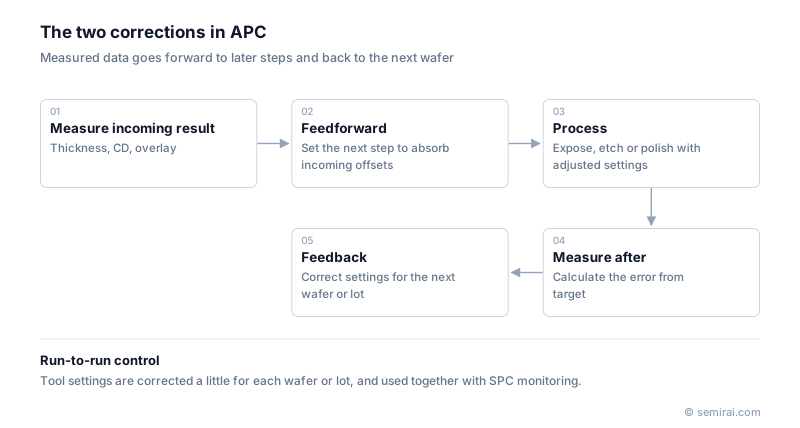
How APC works
The core of APC is run-to-run (R2R) control. After a wafer or lot is processed, metrology measures a result such as critical dimension (CD), film thickness or overlay. The controller compares it with the target, estimates the tool's current offset with a simple model, and changes a recipe parameter, for example exposure dose, etch time or polishing time, for the next run.
Feedforward control looks the other way. If an incoming film is slightly thick, a later step can be told in advance to remove more material. Combining both directions lets a fab absorb tool drift and incoming variation at the same time, across lithography, etch, deposition and chemical mechanical planarization (CMP).
APC, SPC and virtual metrology
Statistical process control (SPC) detects that something has changed; APC corrects it. The two are used together, because a controller that keeps compensating can hide a tool that is slowly failing. SPC charts on the controller's own adjustments show when a correction has grown too large and the tool needs maintenance.
Virtual metrology extends APC by predicting results from tool sensor data, so the controller can act on wafers that were not physically measured. Models must be checked against real measurements regularly, because a drifting model can steer the process the wrong way.
Japanese companies involved
- Hitachi High-Tech's CD-SEM systems provide the line-width measurements that lithography and etch run-to-run controllers commonly use as their input.
- Hitachi High-Tech · CD-SEM metrology, defect inspection and etch systems
FAQ
Which process steps rely most on APC?
Lithography overlay and dose, etch CD and CMP thickness are the classic examples, because they drift with tool condition and incoming wafers and have tight targets. In practice most critical steps in a leading-edge fab run under some form of run-to-run control.
Why is it called advanced?
The name distinguishes model-based automatic correction between runs from simple fixed recipes and manual adjustment by engineers. The control models themselves are often simple, such as weighted moving averages of past offsets.
Related pages
Sources
Last updated: November 2, 2026