Load Port
A load port is the docking unit on the front of a process tool that receives a FOUP or FOSB, positions it, opens its door and connects the carrier's interior to the clean space inside the tool. It is the physical point where a tool meets the fab's automated transport system.
Also called: FOUP load port, FOUP opener
Diagram
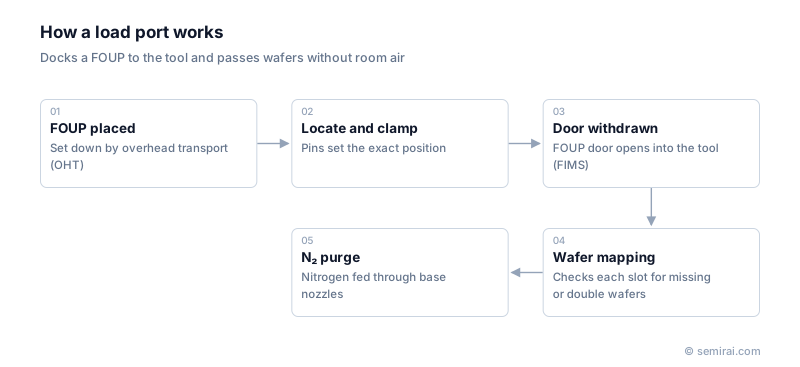
How a load port works
An overhead hoist vehicle lowers the FOUP onto the load port, where kinematic pins locate it and a clamp holds it. Following the SEMI front-opening interface mechanical standard (FIMS), the port's door opener unlatches the FOUP door and withdraws it into the tool, usually moving it down out of the way. The inside of the FOUP is then open only to the tool's mini-environment, never to room air.
Hand-off between the transport vehicle and the port is coordinated by SEMI E84 signals, and the tool reports carrier status to the host via SECS/GEM.
Mapping and purging
Before a robot reaches in, optical sensors scan each slot. This wafer mapping detects empty slots, two wafers in one slot and wafers that sit at an angle, so the robot does not break a wafer. The map is reported to the host and checked against lot records.
Many load ports also purge the FOUP through nozzles on its base, replacing air with nitrogen. Moisture and oxygen left in the pod can oxidise sensitive surfaces or change resist, so purge-capable load ports are increasingly common for interconnect and lithography steps.
Japanese companies involved
- Sinfonia Technology, TDK, RORZE and Hirata Corporation make load ports for semiconductor equipment.
- These companies also supply EFEMs and wafer transfer robots that work behind the load port.
- Hirata Corporation · EFEMs, load ports and wafer transfer units
- Sinfonia Technology · Load ports, EFEMs and wafer transfer robots
- TDK · Magnetic sensors, piezoelectric devices and passive components
- RORZE · Wafer handling robots and sorters
FAQ
How many load ports does a tool have?
Most 300 mm tools have two to four. With more ports, one FOUP can be unloaded and another loaded while the tool keeps processing, which reduces idle time waiting for carriers.
Why does a load port need nitrogen purge?
When the FOUP door is closed, the air inside contains some moisture and oxygen. Over hours of waiting this can grow oxide on copper or alter resists. Flushing the pod with nitrogen keeps the wafers in a dry, inert atmosphere between steps.
Related pages
- EFEM (Equipment Front End Module)
- FOUP (Front Opening Unified Pod)
- FOSB (Front Opening Shipping Box)
- OHT (Overhead Hoist Transport)
- SMIF Pod
- Mini-environment
- End Effector (Wafer Robot Hand)
- SEMI E84 (Parallel I/O Handoff)
- Automated material handling systems (AMHS)
- Miraial 300mm FOUP
- Murata Machinery (Muratec) HTC
- Murata Machinery (Muratec) MDS
- Murata Machinery (Muratec) SRC350X
Sources
Last updated: November 13, 2026