SEMI E84 (Parallel I/O Handoff)
SEMI E84 is the SEMI standard that defines the signal exchange for safely handing off FOUPs between automated transport, such as overhead hoist transport (OHT) vehicles, and the load ports at the front of production equipment. As a vehicle lowers or lifts a FOUP, both sides confirm step by step that the equipment is ready and nothing has gone wrong.
Also called: E84, PIO handoff, carrier handoff interface
Diagram
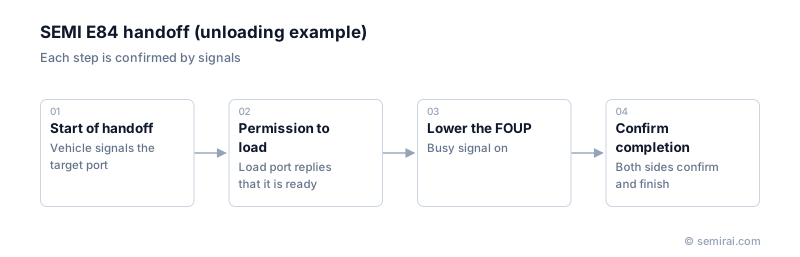
How the handoff works
The exchange uses a set of parallel input/output (PIO) signals that mean things like request to transfer, ready, busy and complete. In a typical unload from the vehicle to the tool, the vehicle signals which port it wants, the load port replies that it can accept, the vehicle lowers the FOUP and reports completion, and the load port confirms it has received the carrier.
The signals are usually exchanged without contact through optical (often infrared) communication units on the vehicle and the load port.
Why it matters
Because the handoff only proceeds when the signals arrive in the defined order, the standard prevents dropped FOUPs, collisions with another carrier and loading into a tool that is busy. If anything goes wrong, an emergency stop signal halts the transfer.
The standard is essential for 300 mm fabs, where nearly every wafer is moved automatically. It lets transport systems and tools from different makers hand off carriers in the same way.
Japanese companies involved
- Daifuku and Murata Machinery make automated material handling systems, including overhead transport, that hand FOUPs to tools.
- TDK and Sinfonia Technology make load ports, the equipment side of the E84 handoff.
- Daifuku · Cleanroom automated material handling systems (AMHS)
- Murata Machinery (Muratec) · Stockers and fab automation
- TDK · Magnetic sensors, piezoelectric devices and passive components
- Sinfonia Technology · Load ports, EFEMs and wafer transfer robots
FAQ
How are E84 signals exchanged?
Usually through optical communication units, often infrared, mounted on the transport vehicle and the load port, so no cable is needed. Signals for transfer request, ready, busy, complete and emergency stop are sent in a defined order, and the handoff continues only when both sides' conditions are met.
How does SEMI E84 differ from SEMI E87?
SEMI E84 covers the physical handoff: the signal sequence between transport system and equipment when a FOUP is set down or picked up. SEMI E87 covers what happens next: communication between the equipment and the factory host to verify the carrier ID and slot map and manage the carrier inside the tool.
Related pages
- OHT (Overhead Hoist Transport)
- Load Port
- FOUP (Front Opening Unified Pod)
- SEMI
- SEMI E87 (Carrier Management Standard)
- SECS/GEM
- Automated material handling systems (AMHS)
- Wafer transfer robots and EFEMs
- Murata Machinery (Muratec) HTC
- Murata Machinery (Muratec) MDS
- Murata Machinery (Muratec) SRC350X
- Murata Machinery (Muratec) SRC600
Sources
Last updated: November 13, 2026