Susceptor
A susceptor is the plate that holds wafers inside epitaxial growth and MOCVD reactors. It absorbs energy from lamps or radio-frequency induction coils and passes the heat evenly to the wafer. The name comes from the part being susceptible to that energy; the wafer is heated through it rather than directly.
Also called: wafer carrier plate, SiC-coated graphite susceptor
Diagram
Materials
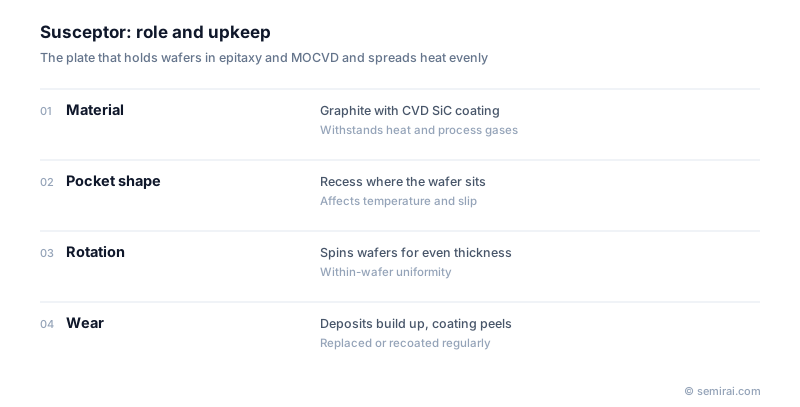
The most common susceptor is graphite coated with silicon carbide (SiC) by chemical vapour deposition. Graphite conducts and stores heat well and is easy to machine, but bare graphite would react with process gases and release carbon. A dense SiC coating seals it. Some applications use quartz, sintered high-purity SiC or aluminium nitride instead.
A large heat capacity is useful: it smooths out uneven heating from lamps or coils, so the temperature across the wafer is more uniform.
Effect on film quality
The wafer sits in a shallow pocket in the susceptor. The shape of the pocket, the contact between wafer and susceptor, rotation and gas flow together set the temperature gradient across the wafer. Steep gradients cause slip, a crystal defect, and affect thickness near the edge and autodoping, where dopant from the wafer back moves into the growing layer.
In SiC epitaxy and compound semiconductor MOCVD, many reactors use planetary or satellite designs that hold several wafers on rotating discs. The susceptor then also sets how many wafers fit in one run, so it is designed together with the reactor.
Japanese companies involved
- Toyo Tanso makes graphite and SiC-coated graphite susceptors for semiconductor processes.
- NGK Insulators makes ceramic susceptors and heaters for wafer processing equipment.
- Kyocera · Package substrates and ceramic components
FAQ
What is the difference between a susceptor and a heater?
A susceptor does not generate heat itself; it receives heat from lamps or induction and passes it on. A ceramic heater has a heating element built in. Both sit under the wafer, but they suit different reactor designs.
How long does a susceptor last?
It is a consumable. Deposits build up on it, the SiC coating can crack or peel, and high temperature can distort it. Flakes of deposit become particles, so fabs replace or recoat susceptors on a fixed schedule rather than waiting for failure.
Related pages
Sources
Last updated: November 2, 2026