Temperature Gradient Method
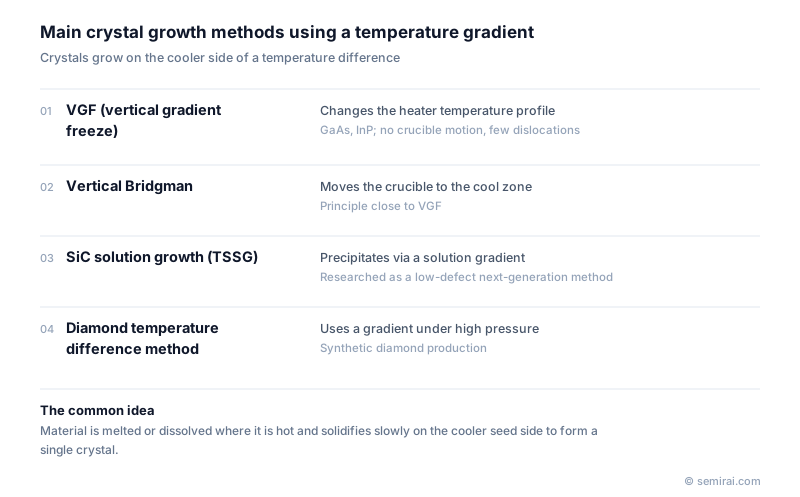
The temperature gradient method is a general term for crystal growth methods that set up a spatial temperature difference, or gradient, inside a vessel and grow the crystal gradually from the cooler side. In semiconductor substrate production, the vertical gradient freeze (VGF) method for compound semiconductors and solution growth of silicon carbide (SiC) are based on this idea.
Also called: VGF, vertical gradient freeze, solution growth, TSSG
Diagram
VGF for GaAs and InP
Vertical gradient freeze (VGF) is one of the main methods for growing gallium arsenide (GaAs) and indium phosphide (InP) single crystals. A seed crystal sits at the bottom of a crucible with the molten source material above it. Without moving the crucible, the furnace heater profile is changed slowly so the crystal freezes upward from the seed.
Its principle is close to the vertical Bridgman (VB) method, which moves the crucible instead. Because VGF can keep the temperature gradient small, the crystal experiences little thermal stress and contains few dislocations.
Solution growth of SiC and other uses
Most SiC crystals are grown by sublimation, called physical vapour transport (PVT). An alternative under development is top-seeded solution growth (TSSG). Carbon is dissolved in a silicon-based solution, and a temperature difference in the solution makes SiC precipitate on a slightly cooler seed crystal. Solution growth may give crystals with fewer defects and is being researched as a next-generation substrate process.
The same principle appears in high-pressure, high-temperature diamond synthesis, where the temperature difference method uses a gradient inside the press to grow diamond crystals.
Japanese companies involved
- Sumitomo Electric Industries makes GaAs and InP substrates and also produces synthetic diamond by high-pressure, high-temperature methods.
- JX Advanced Metals makes InP substrates for optical communication devices.
- Sumitomo Electric Industries (compound semiconductors) · SiC epitaxial wafers and GaAs and InP substrates
- JX Advanced Metals · Sputtering targets and high-purity metals
FAQ
How is VGF different from the vertical Bridgman method?
Both freeze the crystal upward from a seed at the bottom of a vertical crucible. Bridgman moves the crucible toward the colder zone; VGF keeps everything still and changes the heater temperatures. With no mechanical motion and a small gradient, VGF makes it easier to limit dislocations caused by thermal stress.
Why is SiC usually grown by sublimation rather than from a melt?
SiC does not melt at practical pressures; it decomposes instead. Crystals are therefore grown from the vapour (PVT) or from a solution in which carbon is dissolved in molten silicon-based alloy, as in TSSG.
Related pages
- Vertical Bridgman Method (VB)
- Gallium Arsenide (GaAs)
- Indium Phosphide (InP)
- SiC Wafer (Silicon Carbide Substrate)
- PVT (Physical Vapour Transport) Method
- Seed Crystal
- Crystal growth furnaces
- Compound semiconductor substrate equipment (SiC/GaN)
- Daiichi Kiden Round-Chamber Crystal Puller (CZ Method)
- Daiichi Kiden S278 / S380
- Daiichi Kiden Solution Growth System
- Ferrotec FT-CZ1200SE/1400SE
Sources
Last updated: November 13, 2026