Wire Saw
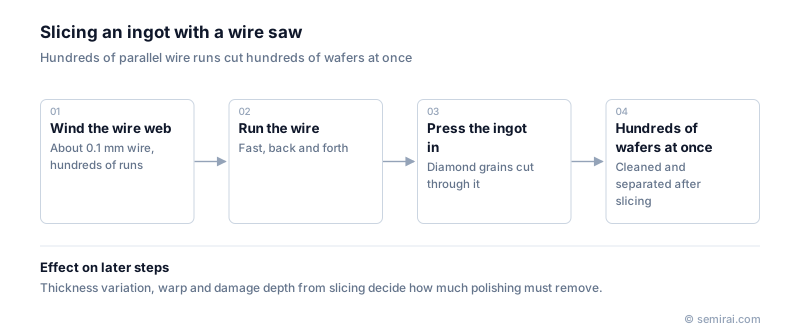
A wire saw slices a crystal ingot into thin wafers by pressing it into a web of fine, fast-moving wire. Wire about 0.1 mm in diameter is wound hundreds of times around grooved guide rollers to form parallel cutting lines, so a single pass cuts hundreds of wafers at the same time.
Also called: multi-wire saw, diamond wire saw
Diagram
Loose abrasive and fixed abrasive
In the older loose-abrasive (slurry) method, a slurry of abrasive grains such as silicon carbide is fed onto plain steel wire. The grains roll between the wire and the crystal and remove material by many tiny fractures, much like lapping.
In the fixed-abrasive method, diamond grains are bonded to the wire by electroplating or resin. Diamond wire cuts faster, needs no abrasive slurry to be handled and recycled, and allows a thinner kerf. It is now the dominant method for slicing silicon.
What slicing decides
Slicing sets the starting quality of each wafer: total thickness variation (TTV), warp, saw marks and the depth of the damaged layer. Wire deflection and vibration during cutting are left behind as surface waviness. All of this has to be removed later by lapping or grinding and polishing, so a better cut means less removal, less material loss and shorter downstream processing.
Kerf loss, the silicon turned into dust by the cut, is a major cost factor because it is comparable in scale to the thickness of a wafer. Thinner diamond wire reduces it, at the price of more wire breakage and tighter tension control.
Wire saws and SiC
For very hard materials such as SiC, wire sawing is slow and the material loss is large. Laser slicing, which splits the wafer along a modified layer formed inside the ingot, is starting to replace wire saws for SiC.
Japanese companies involved
- Komatsu NTC and Takatori make wire saws used to slice silicon and SiC ingots.
- DISCO offers KABRA, a laser slicing process for SiC that is an alternative to wire sawing.
- Komatsu NTC · Wire saws for slicing silicon and SiC ingots
- Takatori · Wire saws, dicing-related equipment and bonding/debonding systems
FAQ
Why does the wire move back and forth?
Running the wire in alternating directions lets a limited length of wire be reused, spreads wear more evenly along it and helps carry debris out of the cut. The pattern of forward and reverse travel is part of the cutting recipe.
Is a wire saw the same as a dicing saw?
No. A wire saw slices an ingot into wafers. A dicing saw uses a thin rotating blade to cut a finished, processed wafer into individual chips at the end of the front-end process.
Related pages
Sources
Last updated: November 13, 2026