Yttria Coating (Plasma-Resistant Coating)
Yttria coating is a layer of yttrium oxide (Y₂O₃) applied, usually by thermal spraying, to the inside parts of plasma process chambers. It slows erosion of liners, showerheads, rings and other parts exposed to fluorine- or chlorine-based plasma, which extends part life and reduces particles falling on wafers.
Also called: Y2O3 coating, yttrium oxide thermal spray coating, plasma-resistant coating
Diagram
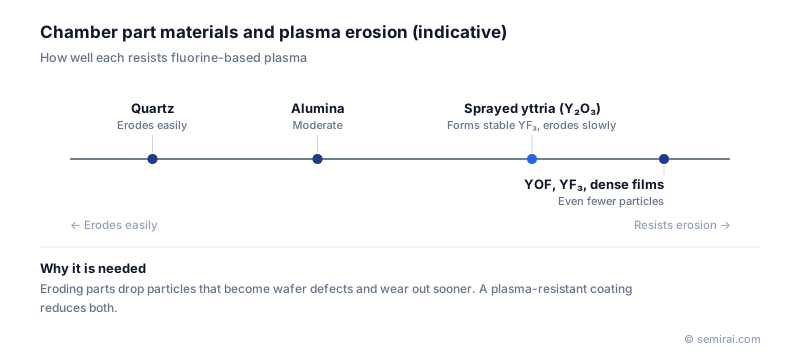
Why yttria resists plasma
Fluorine radicals attack chamber surfaces. On yttria they form yttrium fluoride (YF₃), which is stable and does not evaporate, so it acts as a protective skin and the surface erodes slowly. Alumina forms aluminium fluoride, which is less protective, and quartz is etched readily. Yttria therefore erodes much more slowly than both in typical etch chemistries.
Slower erosion has two benefits. Parts last longer between replacements, and fewer fragments of the chamber wall land on wafers as particle defects.
Coating methods and newer materials
Atmospheric plasma spraying (APS) is the main production method. Sprayed coatings always contain small pores and cracks, so porosity and adhesion to the part decide coating life and particle performance. Where denser, lower-particle films are needed, suppliers use suspension plasma spraying, aerosol deposition, or thin films made by PVD or ALD.
Fluorine-containing coatings such as yttrium fluoride (YF₃) and yttrium oxyfluoride (YOF) are also used. Because they are already close in composition to the fluoride layer that forms during processing, they suffer less volume change and cracking. The best coating depends on the gases, power and temperature of each process, so it is often developed jointly by the tool maker and the coating supplier.
Japanese companies involved
- TOCALO applies thermal spray coatings, including plasma-resistant coatings, to semiconductor equipment parts and refurbishes used parts.
- Fujimi Incorporated sells high-purity yttria powders for thermal spraying.
- Fujimi Incorporated · CMP slurries and polishing materials
- TOCALO · Thermal spray coatings and refurbishment of equipment parts
- Kyocera · Package substrates and ceramic components
- NGK Corporation · Electrostatic chucks, ceramic heaters and susceptors
FAQ
Which parts of an etch tool are coated with yttria?
Mainly the parts that face the plasma: chamber liners and walls, showerheads or gas distribution plates, focus and edge rings, windows and parts around the wafer stage. Each part may use a different coating type and thickness.
Can a worn yttria coating be renewed?
Yes. Used parts are commonly stripped, cleaned and recoated by a coating service company, then returned to the fab. This recycling is an important part of how fabs control the cost of chamber parts.
Related pages
Sources
Last updated: November 2, 2026