Plasma Etching
Plasma etching is the general term for etching methods that create a plasma in a vacuum chamber and remove material from the wafer with the reactive species it produces, mainly radicals and ions. It is often used as a broad name for all dry etching, including reactive ion etching (RIE).
Also called: dry etching, plasma dry etch
Diagram
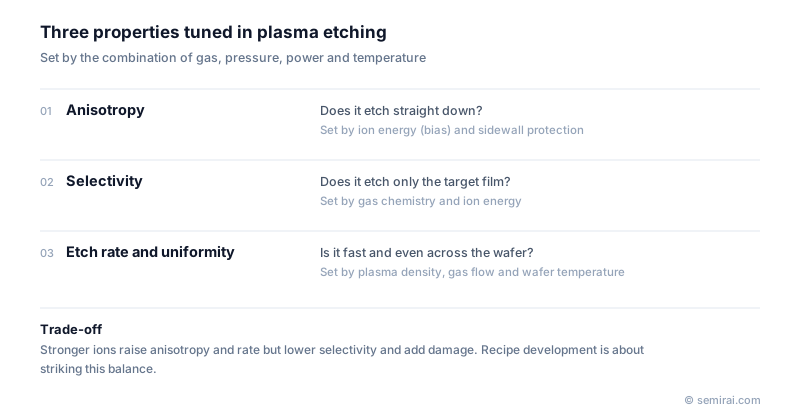
What can be tuned
The strength of plasma etching is that its key properties can be adjusted over a wide range. Anisotropy, selectivity, etch rate and uniformity all depend on the plasma source (CCP, ICP or microwave ECR), pressure, RF source and bias power, gas mixture and flow, and wafer temperature.
These properties trade against each other. Stronger ion bombardment gives more vertical walls and faster etching, but lowers selectivity and increases damage. Developing an etch recipe means finding the balance that a given film and pattern need.
Typical gases for each material
Silicon and polysilicon are usually etched with chlorine, hydrogen bromide or sulphur hexafluoride (SF₆), often with oxygen added. Silicon dioxide is etched with fluorocarbon gases such as C₄F₈, CF₄ and CHF₃, which also leave a protective polymer. Silicon nitride uses hydrofluorocarbons such as CHF₃, and tungsten uses SF₆ or other fluorine chemistries. Copper is not plasma-etched in volume production; copper wiring is formed by the damascene method instead.
Challenges at advanced nodes
The main problems are the microloading effect (etch rate depending on pattern density), aspect-ratio-dependent etching (slower etching in deeper, narrower holes) and profile distortions such as notching and bowing. Pulsed plasmas, precise temperature control, new gases and atomic layer etching are among the methods used to keep these under control.
Japanese companies involved
- Tokyo Electron (TEL) and Hitachi High-Tech make plasma etch systems used in volume production.
- Daikin Industries and Kanto Denka Kogyo supply fluorine-based etching gases, and Shinwa Controls makes chillers that control the temperature of etch chamber components.
- Tokyo Electron (TEL) · Coat/develop, etch and deposition equipment
- Hitachi High-Tech · CD-SEM metrology, defect inspection and etch systems
- Daikin Industries · Etching gases, fluoropolymers and fluoroelastomers
- Kanto Denka Kogyo · Fluorine-based specialty gases
- Shinwa Controls · Chillers, precision air conditioning and fluid control valves
FAQ
Is plasma etching the same as RIE?
RIE is a type of plasma etching in which an RF bias accelerates ions into the wafer so that chemical reaction and ion bombardment work together. Plasma etching is the broader term and also includes radical-driven etching with little ion energy, which is more isotropic.
What do radicals and ions each do?
Radicals are neutral, chemically active fragments that react with the surface to form volatile products. Ions are far fewer but are accelerated vertically by the sheath, breaking bonds and clearing passivation at the bottom of features. Together they give etching that is both fast and directional.
Related pages
- Dry Etching
- RIE (Reactive Ion Etching)
- Etching Equipment
- Plasma (Semiconductor Processing)
- Atomic Layer Etching (ALE)
- Yttria Coating (Plasma-Resistant Coating)
- Charge-up
- Process Chamber
- Dry etching equipment
- Tokyo Electron (TEL) Acrevia™
- Tokyo Electron (TEL) Tactras™
- Elionix EIS-200ERP
- Panasonic Connect APX300-DM
Sources
Last updated: November 13, 2026