Abatement System (Scrubber)
An abatement system, often called a scrubber, treats the exhaust from process tools before it enters the factory exhaust. It burns, decomposes or absorbs gases such as silane, arsine, chlorine compounds and perfluorinated compounds (PFCs), which are flammable, toxic or strong greenhouse gases and cannot be released untreated.
Also called: scrubber, exhaust gas abatement, point-of-use abatement
Diagram
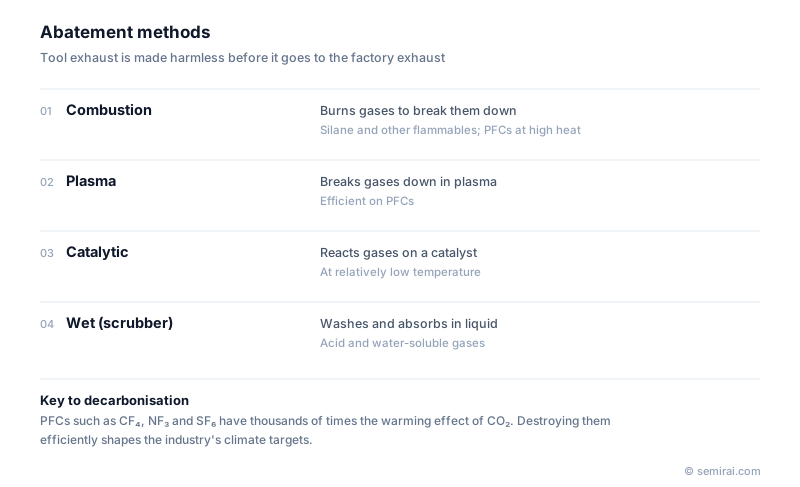
Treatment methods
There are four main methods: combustion with a burner, plasma decomposition, heated catalysts, and wet scrubbing with water or alkaline solution. Many units combine them. A common design burns the gas first and then washes the products: silane, for example, is oxidised to silicon dioxide powder, which the wet stage then removes.
Abatement units usually sit in the subfab next to the dry vacuum pumps they serve. Solid by-products can clog piping, and a blockage raises the pressure at the pump outlet, which can upset pressure control in the process chamber. Pumps and abatement are therefore often designed and maintained as one unit.
PFCs and decarbonisation
Etch and chamber cleaning use gases such as CF₄, C₄F₈, NF₃ and SF₆. Their global warming potential is thousands to over twenty thousand times that of CO₂, and they stay in the atmosphere for a long time, so they are a major part of chipmakers' direct (Scope 1) emissions.
Fabs cut these emissions in two ways: abatement with high destruction and removal efficiency (DRE), using high-temperature combustion or plasma, and process changes such as remote plasma cleaning that uses NF₃ more completely. Climate targets set by large chipmakers are a major reason for upgrading abatement equipment.
Japanese companies involved
- Kanken Techno makes exhaust gas abatement systems for semiconductor fabs.
- Ebara makes dry vacuum pumps and exhaust gas treatment equipment.
- Kanken Techno · Exhaust gas abatement systems (scrubbers)
- Ebara · CMP systems, dry vacuum pumps and exhaust treatment
FAQ
What is DRE in abatement?
Destruction and removal efficiency: the share of a target gas entering the abatement unit that is destroyed or captured. PFCs such as CF₄ are very stable, so reaching a high DRE needs high temperature or plasma and careful design.
Why is abatement placed near each tool rather than centrally?
Treating gas close to the source avoids sending toxic or flammable gas through long ducts, where it could leak, react with other exhaust streams or deposit solids. Central systems still handle general acid and alkaline exhaust downstream.
Related pages
Sources
Last updated: November 1, 2026