Antimony (Sb)
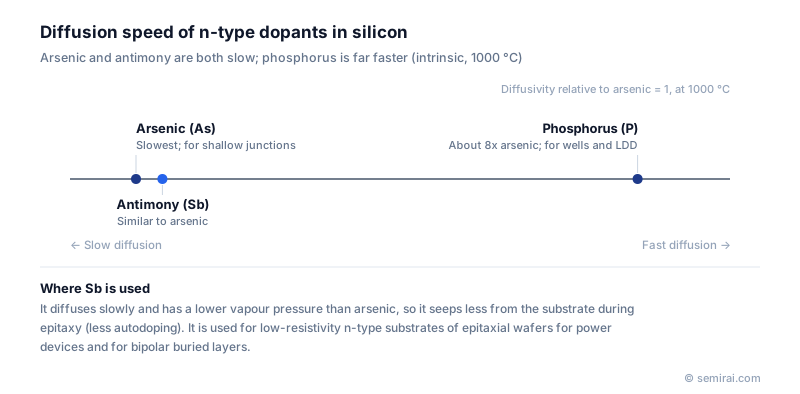
Antimony (Sb), element 51 in group 15, is a donor that makes silicon n-type. It is heavier than phosphorus and arsenic and diffuses very slowly in silicon, which makes it well suited to heavily doped substrates and buried layers that must stay put while other layers are grown on top of them.
Also called: n-type dopant, donor
Diagram
Main use: n+ substrates for epitaxial wafers
Power MOSFETs and many discrete devices are built on n/n+ epitaxial wafers: a lightly doped epitaxial layer on a heavily doped substrate. Epitaxy is done at high temperature, and if dopant escapes from the substrate into the growing layer (autodoping and out-diffusion), the layer's resistivity is wrong. Antimony diffuses slowly and has a lower vapour pressure than arsenic, so it causes less autodoping.
Its drawback is low solid solubility. Antimony-doped substrates cannot go much below about 0.01 Ω·cm, so when lower resistivity is needed, arsenic- or red-phosphorus-doped substrates are used instead. Antimony has also long been used for n+ buried layers in bipolar and BiCMOS processes.
Other uses and supply
Antimony is part of several compound semiconductors: indium antimonide (InSb) for infrared sensors and gallium antimonide (GaSb) substrates for infrared devices. Phase-change memory uses antimony-containing alloys such as Ge₂Sb₂Te₅ (GST), and Sn-Sb alloys are used as high-temperature lead-free solders.
Antimony mining and refining are concentrated in China, and Chinese export controls on antimony introduced in 2024 drew attention to it as a critical mineral.
Japanese companies involved
- SUMCO and Shin-Etsu Chemical make silicon wafers, including epitaxial wafers built on heavily doped substrates for power and discrete devices.
- SUMCO · Silicon wafers
- Shin-Etsu Chemical · Silicon wafers, photoresists and photomask blanks
FAQ
How do antimony, arsenic and phosphorus differ as dopants?
All three are donors. Phosphorus is the lightest and diffuses fastest. Arsenic and antimony are heavier and diffuse much more slowly, at similar rates. Antimony has the lowest solubility, so it cannot be doped as heavily, but it stays in place during high-temperature epitaxy.
Is antimony implanted in chip fabs?
Rarely in modern logic, where arsenic covers shallow n-type regions. Antimony is mainly added to the silicon melt during crystal growth for substrates, or diffused or implanted for buried layers in bipolar and power processes.
Related pages
Sources
Ion implantation and thermal processing terms
Last updated: November 13, 2026