Boron (B)
Boron (B), element 5 in group 13, is the standard acceptor, or p-type dopant, for silicon. A boron atom on a silicon lattice site has one bonding electron too few, so it takes an electron from a neighbour and leaves a mobile hole behind. In practice, boron is almost the only p-type dopant used in silicon integrated circuits.
Also called: p-type dopant, acceptor
Diagram
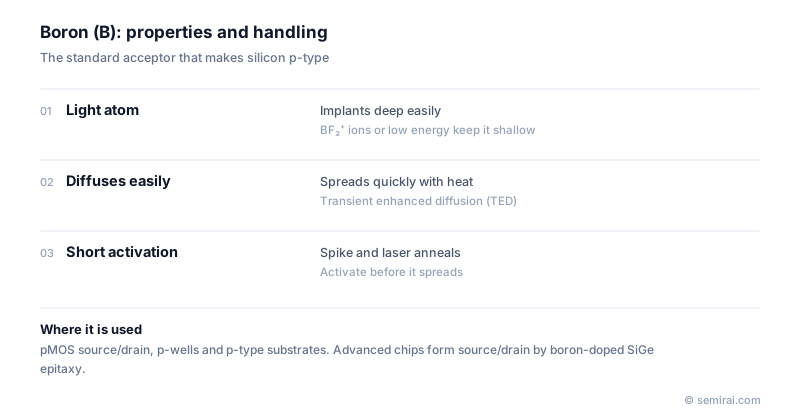
Why boron is hard to keep shallow
Boron is light and small. At a given energy it goes deep into the wafer, so shallow junctions need very low implant energy or heavier carriers: BF₂⁺ ions, or boron cluster ions such as B₁₈H₂₂, in which each boron atom carries only part of the energy. Boron also channels easily, which is countered by tilting the wafer or pre-amorphising the surface with germanium.
Boron diffuses quickly, and damage from implantation makes it diffuse much faster for a short time at the start of annealing (transient enhanced diffusion, TED). Spike, flash lamp and laser anneals are used to activate it before it can spread.
Sources and uses
Boron trifluoride (BF₃) and diborane (B₂H₆) are used as implant sources, and boron tribromide (BBr₃) or solid boron nitride for thermal diffusion. In epitaxy, diborane is added to the process gas to dope SiGe source/drain regions of pMOS transistors heavily in situ. Diborane is toxic and flammable, so it is handled in gas cabinets with abatement, often in sub-atmospheric cylinders.
Boron is also used in p-type wafers, which are grown from boron-doped melts, and was once used in borophosphosilicate glass (BPSG) insulating layers.
Japanese companies involved
- Taiyo Nippon Sanso supplies specialty electronic gases and gas supply systems used to deliver hazardous process gases in fabs.
- Taiyo Nippon Sanso · Specialty gases, gas supply systems and MOCVD equipment
FAQ
Why is BF₂⁺ used instead of B⁺?
In a BF₂⁺ ion the boron atom carries only about one fifth of the ion's energy, because boron makes up about a fifth of the molecule's mass. The implanter can run at a higher, more stable energy while the boron still stops shallow, and the heavier ion also helps amorphise the surface.
Why are there no good alternatives to boron?
Other group-13 elements such as gallium and indium have low solubility in silicon or deep energy levels, so fewer of them supply holes at room temperature. Boron combines high solubility with a shallow acceptor level.
Related pages
Sources
Last updated: November 13, 2026