Projected Range (Rp)
Projected range (Rp) is the mean depth at which accelerated ions come to rest after entering a wafer during ion implantation. The ions do not all stop at one depth: they form a distribution around Rp whose width is described by the standard deviation ΔRp, called straggle. Together Rp and ΔRp give a first description of an implant profile.
Also called: ion range, straggle (ΔRp), implant depth profile
Diagram
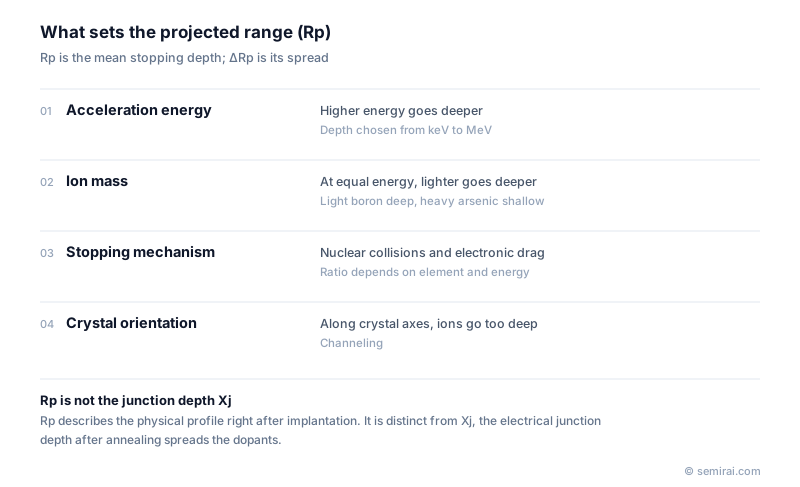
What sets the depth
An ion slows down in two ways. Nuclear stopping is collisions with the nuclei of the target atoms and dominates for heavy ions at low energy. Electronic stopping is drag from the electrons of the solid and dominates for light ions at high energy. The balance between the two depends on the ion species and its energy, so the same acceleration energy gives very different depths: light boron goes deep, heavy arsenic stops shallow.
Energy is the main control. Implanters therefore come in families: high-current machines for heavy doses at low energy, medium-current machines for moderate doses, and high-energy machines reaching MeV levels for deep wells.
Real profiles and design
Real profiles are not perfectly Gaussian. Ions that travel along open crystal directions go much deeper and form a channeling tail, which is why wafers are tilted by about 7 degrees or the surface is pre-amorphised. For shallow p-type junctions, where boron alone would go too deep even at low energy, it is implanted as the heavier molecule BF₂⁺.
Profiles are predicted with Monte Carlo codes such as SRIM and with process simulators, and measured with SIMS.
Japanese companies involved
- Sumitomo Heavy Industries Material Solutions (formerly SMIT) and Nissin Ion Equipment both make ion implanters, the machines whose energy and dose settings determine Rp and the dopant profile.
- Nissin Ion Equipment · Ion implanters
- Sumitomo Heavy Industries Material Solutions (formerly SMIT) · Ion implanters
FAQ
Why does boron go deeper than arsenic at the same energy?
Boron is about seven times lighter than arsenic. Light ions lose energy mainly to electrons, which slows them gradually, while heavy ions lose large amounts of energy in collisions with silicon nuclei. Arsenic therefore stops much closer to the surface.
Is Rp the same as the junction depth?
No. Rp describes where the ions stop right after implantation. The junction depth (Xj) is the electrical depth where the dopant concentration equals the background doping after annealing. Annealing spreads the dopants, so Xj is deeper than Rp, and limiting that spread is the purpose of thermal budget control.
How do engineers make a shallower boron implant?
They lower the energy, implant BF₂⁺ or boron cluster ions so that each boron atom carries only part of the energy, pre-amorphise the surface to remove the channeling tail, and activate with a very short anneal.
Related pages
Sources
Last updated: November 2, 2026