Fick's Laws of Diffusion
Fick's laws are the basic laws of diffusion, the spreading of a substance from regions of high concentration to regions of low concentration. The first law states that the diffusion flux is proportional to the concentration gradient, J = −D dC/dx; the second describes how the concentration changes with time. They underpin every calculation of dopant movement in silicon.
Also called: Fick's first law, Fick's second law, diffusion coefficient
Diagram
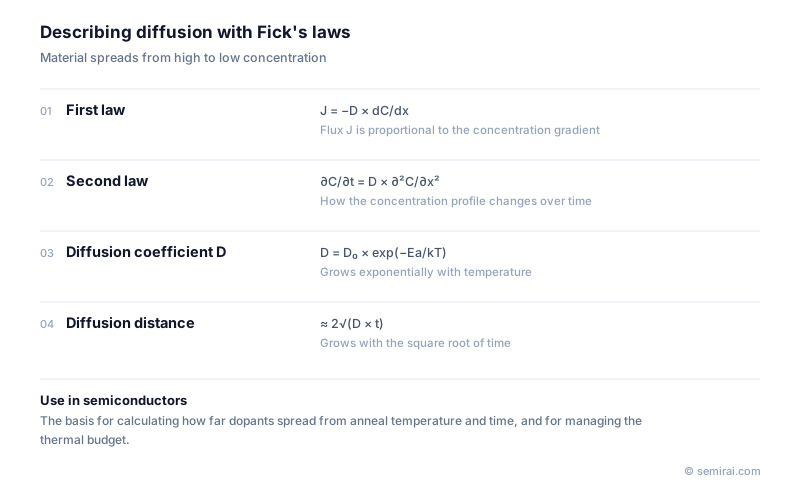
The two laws
Adolf Fick published the laws in 1855. In the first law, J is the amount of material crossing a unit area per unit time, and the constant D is the diffusion coefficient, which says how fast the material spreads. Combining it with conservation of mass gives the second law, ∂C/∂t = D ∂²C/∂x², which gives the concentration at every point as time passes.
Solving the second law gives two standard profiles. When the surface concentration is held constant, as in diffusion from a gas source, the profile follows a complementary error function (erfc). When a fixed amount of dopant is introduced first and then driven in, as in annealing after an implant, the profile is Gaussian. The typical distance moved is the diffusion length, √(Dt).
Temperature and real dopants
The diffusion coefficient follows the Arrhenius law, D = D₀ exp(−Ea/kT). For common dopants in silicon, a rise of 100 °C near 1000 °C increases D by about an order of magnitude. This is why the temperature and duration of every hot step, the thermal budget, are tightly controlled, and why spike and flash lamp anneals are used to activate dopants with minimal spreading.
Real dopant diffusion often departs from simple Fick behaviour. Point defects, internal electric fields and high concentration can all speed it up, as in transient enhanced diffusion. Process simulators add these effects to the basic equations.
Japanese companies involved
- Kokusai Electric and Tokyo Electron make vertical batch furnaces whose temperature profiles are designed with diffusion calculations of this kind.
- Kokusai Electric · Batch deposition, diffusion and ALD equipment
- Tokyo Electron (TEL) · Coat/develop, etch and deposition equipment
FAQ
Which law is used to calculate dopant profiles?
The second law. The first law gives the flux at one instant; the second follows the whole concentration profile through time, with boundary conditions chosen to match the process, such as a constant surface source or a fixed implanted dose.
If annealing time is doubled, how much further do dopants move?
Only about 1.4 times further, because the diffusion length grows with the square root of time. Raising the temperature has a much larger effect, since D grows exponentially with temperature.
Related pages
Sources
Last updated: November 2, 2026