Phosphorus (P)
Phosphorus (P), element 15 in group 15, is the most common donor, or n-type dopant, for silicon. On a silicon lattice site it has one valence electron left over after bonding, and at room temperature nearly all of these electrons are free to carry current, making the silicon n-type.
Also called: n-type dopant, donor
Diagram
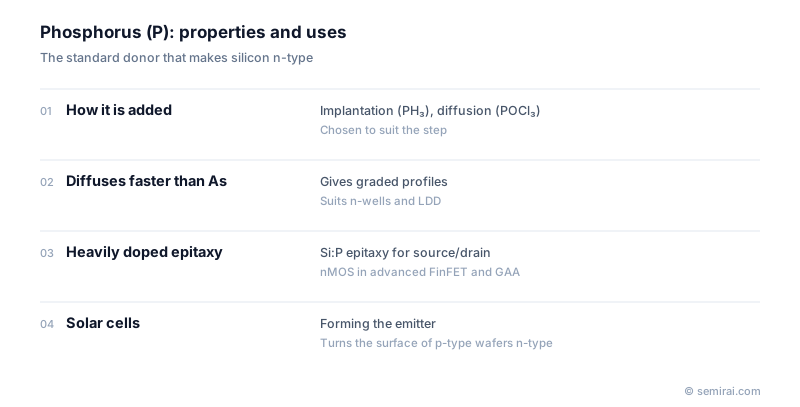
How phosphorus is introduced
Phosphorus is added by ion implantation, thermal diffusion or in-situ doping. Implanters produce phosphorus ions from phosphine (PH₃) or other sources. In thermal diffusion, liquid phosphorus oxychloride (POCl₃) is vaporised in a diffusion furnace and diffuses in from the surface; this is still widely used to form the n-type emitter of crystalline silicon solar cells.
Phosphorus is lighter than arsenic and diffuses faster, so it suits regions that are deep or graded: n-wells, lightly doped drain (LDD) regions and doped polysilicon gates. In advanced FinFETs, nMOS source/drain regions are grown as silicon epitaxy heavily doped with phosphorus (Si:P).
Other uses
Phosphosilicate glass (PSG) and borophosphosilicate glass (BPSG) soften when heated, which smooths the surface, and they trap mobile ions such as sodium. They were the standard insulating layers before chemical mechanical polishing took over planarisation.
For power devices, float-zone silicon is doped by neutron transmutation doping (NTD), which turns some silicon atoms into phosphorus. Phosphorus is also a constituent of compound semiconductors such as indium phosphide (InP) and gallium phosphide (GaP). Phosphine is highly toxic, so its supply and exhaust are treated by abatement systems.
Japanese companies involved
- Taiyo Nippon Sanso supplies specialty electronic gases and the gas supply systems that deliver hazardous dopant gases such as phosphine safely to process tools.
- Taiyo Nippon Sanso · Specialty gases, gas supply systems and MOCVD equipment
FAQ
When is phosphorus used instead of arsenic?
Both are donors. Phosphorus diffuses faster and is lighter, so it is used where a deeper or more gradual profile is wanted, such as wells and LDD regions. Arsenic is heavy and diffuses slowly, so it is chosen for shallow, abrupt nMOS source/drain junctions.
What is neutron transmutation doping?
Silicon is exposed to neutrons in a nuclear reactor. The isotope ³⁰Si captures a neutron and decays to ³¹P, so phosphorus is created uniformly throughout the crystal. The very even resistivity suits float-zone wafers for high-voltage power devices.
Related pages
Sources
Last updated: November 13, 2026