Forming Gas
Forming gas is a mixture of nitrogen with a few percent of hydrogen. It provides the reducing action of hydrogen, which removes oxygen from oxides, while keeping the hydrogen concentration too low to burn, so it is much safer to handle than pure hydrogen. In chipmaking it is used to improve transistor interfaces and to protect metal surfaces from oxidation.
Also called: forming gas anneal, FGA, hydrogen anneal
Diagram
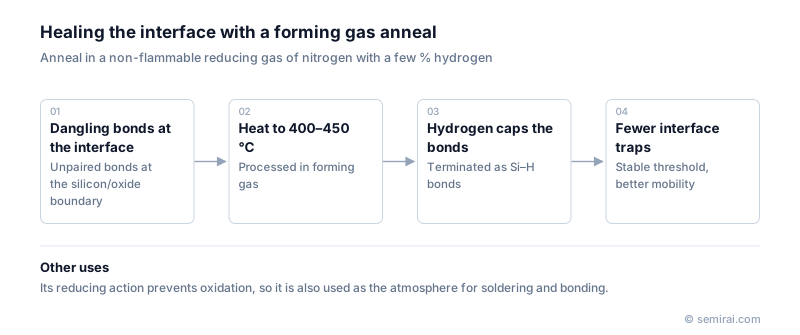
Forming gas anneal
At the interface between silicon and the gate oxide, some silicon atoms are left with unpaired bonds, called dangling bonds. They act as interface traps that capture carriers, shift the threshold voltage, lower mobility and add noise. Heating the wafer in forming gas at around 400–450 °C lets hydrogen bond to these sites as Si–H, which removes most of the traps.
The anneal is usually done near the end of the process, after interconnects are formed. Its temperature is low enough for aluminium and copper wiring, and the hydrogen can reach the interface through the layers above.
Uses in assembly
In soldering, die bonding and copper wire bonding, oxide on metal surfaces prevents wetting and good joints. A forming gas atmosphere stops oxidation and can reduce thin oxides, which makes fluxless assembly possible. Hydrogen-containing atmospheres are also used when annealing electroplated copper interconnects, so that the grains grow without the copper oxidising.
Japanese companies involved
- Taiyo Nippon Sanso supplies industrial and electronic gases, including nitrogen and hydrogen, together with gas supply systems for fabs.
- Kokusai Electric makes vertical batch furnaces that are used for annealing processes such as forming gas anneals.
- Taiyo Nippon Sanso · Specialty gases, gas supply systems and MOCVD equipment
- Kokusai Electric · Batch deposition, diffusion and ALD equipment
FAQ
How much hydrogen does forming gas contain?
It depends on the application, but it is usually a few percent, kept below the level at which the mixture could burn if it leaked into air. Higher hydrogen content is used only with equipment designed for flammable gas.
Does the hydrogen passivation last for ever?
Not always. Si–H bonds at the interface can be broken again by hot carriers or by stress at high temperature and voltage, which is one mechanism behind transistor ageing. Replacing hydrogen with deuterium has been studied because the Si–D bond is harder to break.
Related pages
Sources
Last updated: November 12, 2026