Cantilever
A cantilever is a beam fixed at one end and free at the other. When a force acts on the free end, the beam bends by an amount proportional to that force, so it can act as a spring that turns tiny forces into measurable displacement. In semiconductors it appears as the AFM probe, as the needles of cantilever probe cards and as moving parts in MEMS devices.
Also called: cantilever beam, AFM cantilever, cantilever probe
Diagram
Cantilevers in atomic force microscopy
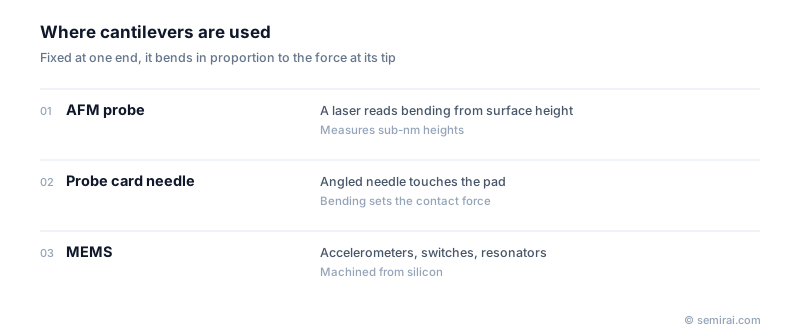
An AFM cantilever is a thin silicon or silicon nitride beam, typically around a hundred micrometres long, with a sharp tip only nanometres across at its end. As the tip scans a surface, forces between tip and sample bend the beam. A laser reflected from its back onto a split photodetector, the optical lever, turns very small deflections into a large, easily measured signal.
Cantilevers are chosen by spring constant and resonance frequency. Soft beams suit contact mode, where the tip drags lightly across the surface, while stiffer, high-frequency beams suit tapping mode, where the beam vibrates and touches the surface only briefly. Fabs use AFM for roughness, step height and flatness after polishing.
Cantilever probe cards
The cantilever probe card is the oldest probe card design for wafer test. Fine metal needles, often tungsten or tungsten alloys, extend at an angle from a ring and touch the pads of each chip to connect it to the tester. As the wafer is pushed up, the needles bend, which sets the contact force and makes the tip scrub through thin oxide on the pad for a reliable connection.
The design is simple and relatively inexpensive, but the number and arrangement of needles is limited because they must fan in from the edge. Chips with many pads at fine pitch, or testing many chips at once, therefore use vertical or MEMS probe cards. In MEMS devices, silicon cantilevers act as accelerometer masses, switches and resonators.
Japanese companies involved
- Japan Electronic Materials (JEM) and Micronics Japan make probe cards for wafer test, including cantilever designs as well as vertical and MEMS types.
- Japan Electronic Materials (JEM) · Probe cards for wafer test
- Micronics Japan · Probe cards
FAQ
Why is a cantilever good for measuring small forces?
Its deflection is proportional to force, following Hooke's law, and a thin, long beam has a low spring constant, so even nanonewton forces produce a measurable bend. The optical lever then amplifies that bend into a signal large enough to read precisely.
Do cantilever probe needles wear out?
Yes. Repeated touchdowns wear and contaminate the tips, so probe cards are cleaned periodically on an abrasive sheet and needles are realigned or replaced. Tip condition affects contact resistance and therefore test results.
Related pages
Sources
Inspection and metrology terms
Last updated: November 13, 2026