Ellipsometry (Spectroscopic Ellipsometry)
Ellipsometry measures film thickness and optical properties by shining polarised light on a sample and analysing how reflection changes the polarisation state. The name comes from the elliptical polarisation of the reflected light. It measures films without contact and with sub-nanometre precision, making it one of the most widely used thickness methods in fabs.
Also called: spectroscopic ellipsometry, SE
Diagram
What is measured
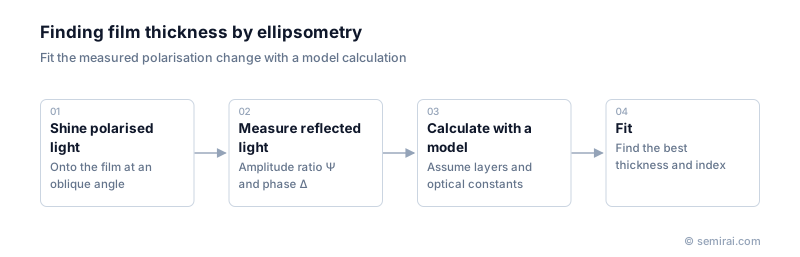
Light is split into two polarisation components, p (parallel to the plane of incidence) and s (perpendicular to it). The instrument measures two values: Ψ, related to the ratio of the reflection amplitudes of p and s light, and Δ, their phase difference. These depend on the thickness and refractive index of each film and on the substrate below.
Ψ and Δ do not give thickness directly. The analyst builds a model of the layer stack with assumed optical constants for each material, calculates the expected Ψ and Δ, and adjusts thicknesses until the calculation fits the measurement. Spectroscopic ellipsometry repeats the measurement over many wavelengths, which lets it resolve several layers at once.
Use in the fab
Ellipsometers measure gate oxides only a few nanometres thick, high-k films, nitrides and photoresist on production lines every day, as part of inline metrology. Because the result depends on the model, new materials and complicated stacks are checked against cross-section TEM before a model is trusted.
The same polarisation approach extended to periodic patterns becomes optical critical dimension (OCD) metrology, also called scatterometry, which measures line width, height and sidewall angle of gratings.
Japanese companies involved
- HORIBA makes spectroscopic ellipsometers for thin-film research and production.
- Otsuka Electronics makes optical film thickness measurement systems and ellipsometers.
- Otsuka Electronics · Film thickness measurement and ellipsometers
- HORIBA · Mass flow controllers and process monitoring instruments
FAQ
How does ellipsometry differ from reflectometry?
Reflectometry fits only the reflected intensity versus wavelength. Ellipsometry also measures the phase change, which makes it far more sensitive to very thin films and better at separating thickness from refractive index. Reflectometry is still used for fast measurements of thicker films.
Why is the measurement angle oblique?
The difference between p and s reflection is largest at oblique angles, typically around 65° to 75° for silicon substrates, close to its Brewster angle. Measuring there gives the strongest sensitivity to the film.
Related pages
Sources
Last updated: November 13, 2026