Probe Card
A probe card is the interface fixture used in wafer test: it carries fine metal probes that touch the electrode pads of the chips on a wafer and connect them to the automatic test equipment (ATE). Each touchdown can contact several dies at once, so many chips are tested in parallel before the wafer is diced.
Also called: wafer probe card
Diagram
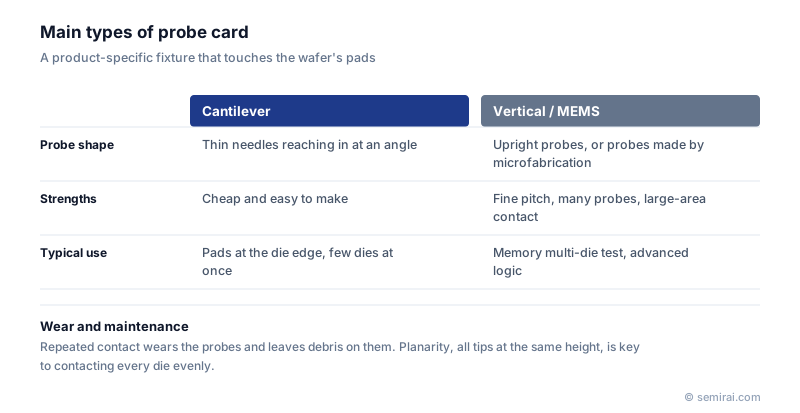
Main types of probe card
Cantilever probe cards use thin needles that reach in at an angle from the edge of the card. They are inexpensive and easy to make, and they suit chips whose pads sit around the die edge, but they are hard to scale to very fine pitches and large pin counts.
Vertical probe cards hold straight probes upright in guide plates, giving uniform contact and better high-frequency behaviour. MEMS probe cards use probes made with semiconductor-style microfabrication, which allows very fine pitch and tens of thousands of probes over a large area. Memory makers use large MEMS cards to test many dies in a single touchdown, and advanced logic uses vertical or MEMS cards for dense area-array pads.
Wear, maintenance and cost
Every touchdown scrubs the probe tips against the pads, so tips wear and pick up debris. Fabs clean and polish the tips on a schedule and monitor contact resistance, because a dirty probe can make a good die look bad. Planarity, meaning that all probe tips sit at the same height, is essential for contacting every die evenly.
A probe card is designed for one product's pad layout, so each new chip needs its own card, and cards are replaced as they wear out. That makes probe cards a significant running cost of testing. Chiplet designs add pressure because each die must be proven good at wafer level before it is assembled into an expensive package.
Japanese companies involved
- Micronics Japan (MJC) designs and manufactures probe cards, including types used for memory wafer testing.
- Tokyo Seimitsu (ACCRETECH) makes wafer probers, the machines that hold the wafer and move it under the probe card during testing.
- Micronics Japan · Probe cards
- Tokyo Seimitsu (ACCRETECH) · Wafer probers, dicing and grinding machines, metrology
- Advantest · Automated test equipment (ATE) for SoC and memory
FAQ
What is the difference between a probe card and a prober?
The probe card is the fixture with the needles. The prober is the machine that loads the wafer, aligns it with a camera, and steps it from die to die under the card. The tester sends and measures the signals that pass through the card.
What is a test socket, and how does it relate to a probe card?
A test socket does the same job after packaging: it contacts the package terminals during final test. The probe card contacts bare dies on the wafer; the socket contacts finished packages handled by a test handler.
Comparisons
Related pages
Sources
Last updated: November 13, 2026