Coulomb Effect
The Coulomb effect, also called the space-charge effect, is the mutual repulsion of electrons in an electron beam. Because every electron carries the same negative charge, the beam spreads and blurs and the image position can shift. It is one of the factors that limit electron-beam writers and electron-beam inspection tools.
Also called: space-charge effect, Coulomb interaction
Diagram
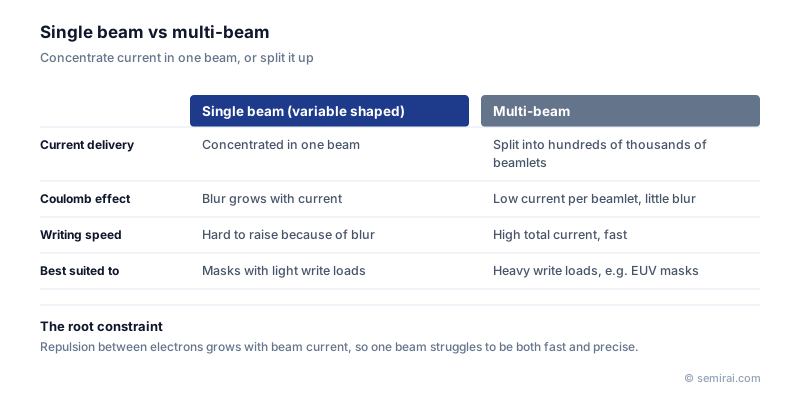
The speed-versus-blur trade-off
The more current a beam carries, the more electrons pass per unit time, the closer they are to each other and the stronger the repulsion. Blur therefore grows with beam current.
Electron-beam writing faces a built-in contradiction. Writing faster means delivering more electrons to the resist in less time, which requires more current, but more current blurs the pattern. Current can only be raised as far as accuracy allows, and this is the fundamental reason electron-beam writing throughput is hard to increase.
How multi-beam writers get around it
Multi-beam mask writers were developed to escape this limit. Instead of one large beam, they split the current into hundreds of thousands of small beamlets that write in parallel. Total current can be large, while the current in each beamlet, and the electron density along the beam path, stay low.
Blur is held down while writing speed rises sharply. This has made multi-beam writers the tool of choice for masks with very large write loads, such as EUV masks and masks with curvilinear shapes. Electron-beam inspection tools are moving to multiple beams for the same reason.
Japanese companies involved
- NuFlare Technology makes both variable-shaped single-beam and multi-beam electron-beam mask writers.
- JEOL makes electron-beam lithography systems, in which beam current is balanced against Coulomb blur.
- NuFlare Technology · Electron-beam mask writers, mask inspection and epitaxial reactors
- JEOL · Electron beam lithography systems, electron microscopes and surface analysis
FAQ
Does the Coulomb effect only blur the beam?
No. It has two parts. Random interactions between individual electrons spread their energies and directions, causing blur that cannot be corrected. The average space charge acts like a weak lens that shifts focus and image position; this part is systematic and can be partly compensated by refocusing.
Does higher acceleration voltage help?
Yes, to a degree. Faster electrons spend less time in the column, so they have less time to push each other apart. Higher voltage also reduces forward scattering in the resist. It increases backscattering and resist heating, however, so writers balance voltage against these effects.
Related pages
Sources
Last updated: November 13, 2026