HSQ (Hydrogen Silsesquioxane)
HSQ (hydrogen silsesquioxane) is an inorganic material of cage-like molecules made of silicon, oxygen and hydrogen. It is one of the highest-resolution resists for electron-beam lithography. It works as a negative resist: where the electron beam strikes, molecules link together and become insoluble in the developer.
Also called: hydrogen silsesquioxane
Diagram
Why HSQ resolves so finely
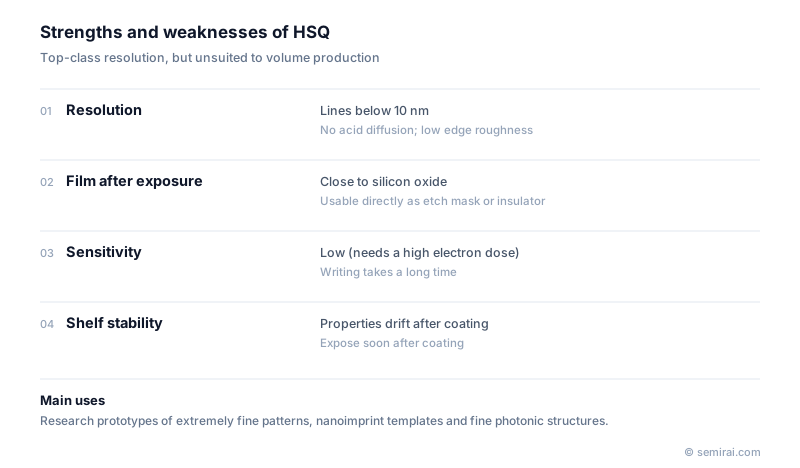
HSQ can form lines below 10 nm with low line-edge roughness. Its molecules are small, and unlike chemically amplified resists it has no acid that diffuses away from the exposed spot, so the reaction stays where the electrons land.
It is developed in an aqueous TMAH solution. After exposure, HSQ becomes a film close to silicon oxide, so the patterned resist can serve directly as an etch mask or even as an insulating layer. HSQ was originally developed as a spin-on low-k dielectric material.
Limitations and uses
HSQ has low sensitivity: it needs a large electron dose, so writing takes a long time. Its properties also change during storage after coating, so it is normally exposed soon after it is spun on.
For these reasons it is not used for production lithography. It is used in research for extreme-scale prototype patterns, for making nanoimprint templates, and for fabricating fine photonic structures.
Japanese companies involved
- Elionix and JEOL make electron-beam lithography systems that research groups use to write high-resolution patterns in resists such as HSQ.
FAQ
How does HSQ compare with PMMA?
Both are classic high-resolution electron-beam resists. PMMA is an organic positive resist, while HSQ is an inorganic negative resist. HSQ gives an oxide-like pattern with better etch resistance and is favoured for isolated lines and pillars; PMMA suits trenches and holes and is easier to strip.
Why does coated HSQ need to be exposed quickly?
The Si-H bonds in the film slowly react with moisture and begin cross-linking even without exposure. Over time this changes the film's sensitivity and contrast, so results drift. Labs therefore coat, bake and expose HSQ within a short, consistent interval and store the liquid cold.
Related pages
Sources
Last updated: November 13, 2026