Direct and Indirect Bandgap
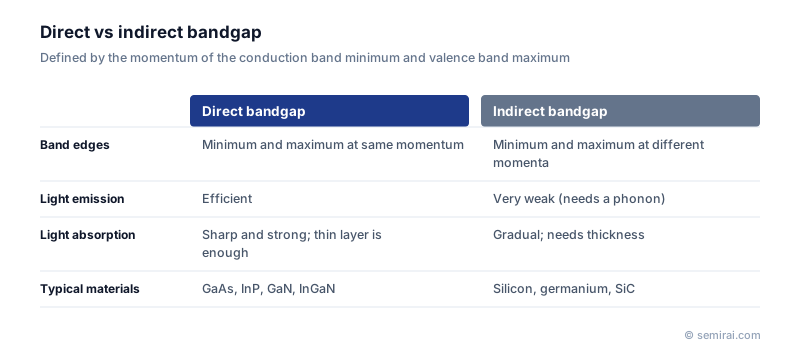
Direct and indirect bandgaps describe two ways electrons can cross the bandgap of a semiconductor, emitting or absorbing light. In a direct-bandgap material the bottom of the conduction band and the top of the valence band occur at the same crystal momentum. In an indirect-bandgap material they occur at different momenta.
Also called: direct transition, indirect transition, direct-gap semiconductor
Diagram
Light emission
In a direct-bandgap semiconductor, an electron can drop from the conduction band to the valence band without changing momentum, so recombination with a hole emits a photon efficiently. GaAs, InP, GaN and InGaN are direct-bandgap materials and are used in LEDs and laser diodes.
In an indirect-bandgap semiconductor, the electron must also exchange momentum with a lattice vibration (a phonon) when it recombines. Because two particles must take part at once, light emission is far less likely and most of the energy ends up as heat. Silicon, germanium and SiC are indirect, which is why silicon is not used for light-emitting devices.
Light absorption
The difference also shows in absorption. A direct-bandgap material absorbs strongly as soon as the photon energy exceeds the bandgap, so a few micrometres can absorb most of the light. An indirect material absorbs more gradually and needs a much thicker layer.
This is why crystalline silicon solar cells use wafers well over a hundred micrometres thick, while GaAs solar cells can be thin films. It also explains why silicon image sensors need deep photodiodes to catch red and near-infrared light.
Japanese companies involved
- Nichia makes LEDs and laser diodes from GaN and InGaN, direct-bandgap materials that emit light efficiently.
- Nichia · LEDs and laser diodes
FAQ
Which common semiconductors are direct and which are indirect?
Direct: GaAs, InP, GaN, InGaN and ZnO. Indirect: silicon, germanium, SiC and GaP. In alloys and strained or very thin layers the type can change with composition, so AlGaAs, for example, becomes indirect at high aluminium content.
Can silicon be made to emit light?
Only weakly. Researchers have studied porous silicon, nanocrystals and strained germanium, but none matches compound semiconductors in efficiency. Silicon photonics therefore attaches separate III-V laser chips, or bonds III-V material onto silicon, to provide the light source.
Related pages
Sources
Last updated: November 12, 2026