DUV Lithography
DUV (deep ultraviolet) lithography is optical lithography that uses a krypton fluoride (KrF, 248 nm) or argon fluoride (ArF, 193 nm) excimer laser as its light source. Combined with immersion and multiple patterning, it can print very fine features, and it remains the workhorse of volume production alongside the newer EUV systems.
Also called: deep ultraviolet lithography, ArF lithography, KrF lithography, ArF immersion
Diagram
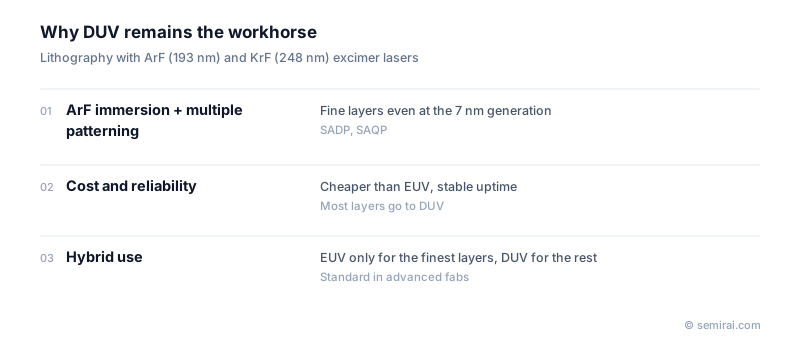
How DUV reaches small features
A DUV scanner projects the image of a photomask through a reduction lens onto photoresist on the wafer, scanning the mask and wafer in step. The smallest printable feature depends on the wavelength and on the numerical aperture (NA) of the lens. ArF immersion (ArFi) fills the gap between the final lens element and the wafer with ultrapure water, which raises the effective NA above 1 and allows finer patterns than dry ArF.
Below the single-exposure limit of ArF immersion, chipmakers use multiple patterning. Self-aligned double patterning (SADP) and self-aligned quadruple patterning (SAQP) use deposited spacers to divide the pitch by two or four. This is how 10 nm and 7 nm class logic was built without EUV, at the cost of many extra deposition, etch and lithography steps.
Why DUV is still the main tool
Even in fabs with EUV, only the most critical layers are exposed with EUV. Most other layers, and nearly all layers of mature-node logic, analog, power and sensor chips, are exposed with DUV. DUV scanners cost much less than EUV systems, run with high uptime, and are widely available on the used equipment market.
Fabs therefore choose the light source layer by layer: EUV for the tightest pitches, ArF immersion for fine layers, dry ArF and KrF for less demanding ones, and i-line (365 nm) for the coarsest. This mix-and-match approach keeps the overall cost of patterning down.
Japanese companies involved
- Nikon makes ArF immersion, dry ArF, KrF and i-line lithography systems, including its NSR series of scanners.
- Canon makes KrF and i-line lithography systems used widely for mature-node and power devices.
FAQ
Who makes DUV lithography systems?
ASML of the Netherlands (TWINSCAN NXT and XT series), Nikon and Canon are the three main makers. ASML and Nikon offer ArF immersion systems; Canon focuses on KrF and i-line systems.
What is the difference between DUV and EUV?
EUV uses 13.5 nm light, more than ten times shorter than ArF, so it can print fine patterns in one exposure. EUV needs reflective optics in vacuum and costs much more per tool, while DUV uses refractive lenses in air or water.
Why is water used in immersion lithography?
Water has a higher refractive index than air at 193 nm, so placing it between lens and wafer lets the lens capture light at steeper angles. That raises the numerical aperture and improves resolution without changing the wavelength.
Related pages
Sources
Last updated: November 2, 2026