Light-Emitting Diode (LED)
A light-emitting diode (LED) is a diode that emits light when forward current flows through its pn junction and electrons and holes recombine, releasing their energy as photons. Because it converts electricity directly into light, it is efficient and long-lived, and its colour is determined by the band gap of the semiconductor.
Also called: LED, light-emitting diode, blue LED, white LED
Diagram
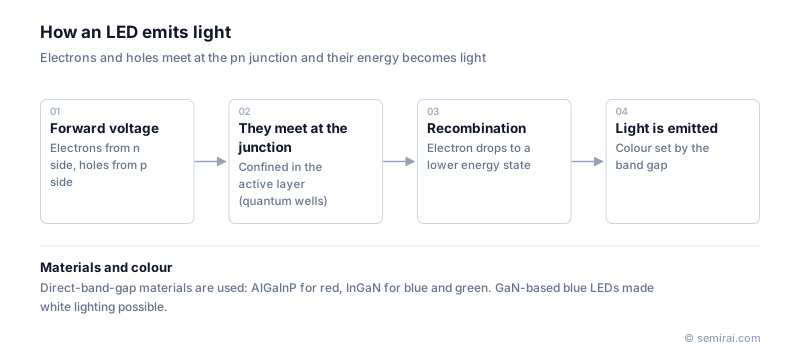
How an LED emits light
Under forward bias, electrons flow in from the n side and holes from the p side. Modern LEDs confine them in a thin active layer, usually a set of quantum wells, so that they meet and recombine efficiently. When an electron falls into a hole, the energy released, roughly equal to the band gap, leaves as a photon.
This works well only in direct-band-gap materials, where recombination emits light rather than heat. Silicon is an indirect-band-gap material and makes a very poor LED, so LEDs are built from compound semiconductors grown epitaxially on substrates such as sapphire, SiC or GaAs.
Materials and colour
A larger band gap gives a shorter wavelength. Red, orange and yellow LEDs use AlGaInP, and earlier red LEDs used GaAsP. Green and blue LEDs use InGaN, a gallium nitride based alloy. Efficient blue LEDs were long out of reach because high-quality GaN crystals and p-type GaN were hard to make. Their development in the early 1990s completed the set of primary colours, earning Isamu Akasaki, Hiroshi Amano and Shuji Nakamura the 2014 Nobel Prize in Physics.
White LEDs usually combine a blue LED with a phosphor that converts part of the light to yellow or to red and green. This made LED lighting practical, and LEDs now dominate general lighting, display backlights, vehicle lamps and traffic signals. Micro-LED displays, built from arrays of very small LEDs, are under development.
Japanese companies involved
- Nichia commercialised the first high-brightness InGaN blue LEDs in 1993 and makes LEDs and laser diodes for lighting, displays and vehicles.
- Stanley Electric makes LEDs for automotive lighting and displays, and ROHM makes indicator and display LEDs.
- Stanley Electric · LEDs, VCSELs and optical sensors
- ROHM · SiC and silicon power devices, analog ICs
- Nichia · LEDs and laser diodes
FAQ
Why are LEDs more efficient than incandescent bulbs?
An incandescent bulb heats a filament and most of its energy is emitted as infrared heat. An LED produces light directly from recombination at a narrow wavelength, so far more of the electrical input ends up as visible light.
What is the difference between an LED and a laser diode?
Both emit light from recombination at a junction. A laser diode adds an optical cavity and runs at high current density, so emission is stimulated and the output is coherent and narrow in wavelength. An LED emits incoherent light over a wider spectrum.
Do LEDs wear out?
Yes, but slowly. Their light output gradually falls as the chip and phosphor age, mostly due to heat. Good thermal design is therefore the key to long life.
Related pages
Sources
Last updated: November 2, 2026