Laser Diode (LD)
A laser diode (LD), or semiconductor laser, is a device that turns the light from electron-hole recombination at a pn junction into laser light by amplifying it in an optical resonator. The output is coherent, nearly single-wavelength and tightly directed, which sets it apart from an LED made of similar materials.
Also called: semiconductor laser, diode laser
Diagram
How a laser diode works
Forward current injects electrons and holes into a thin active layer. At low current they recombine at random and the device glows like an LED, a process called spontaneous emission. The two ends of the chip act as mirrors, so light travels back and forth through the active layer. Once the current passes the threshold, photons trigger further recombination that emits identical photons (stimulated emission), the gain exceeds the losses and the device starts to lase.
Because the light is in phase and comes from a narrow stripe, it can be focused to a small spot or coupled efficiently into an optical fibre. Modern devices use quantum wells and double heterostructures to confine both carriers and light, which keeps the threshold current low.
Materials and applications
The emission wavelength is set by the bandgap of the active layer, so different compound semiconductors cover different uses. GaAs-based lasers emit in the red and near infrared, InP-based lasers cover the 1.3 µm and 1.55 µm bands used in fibre communication, and GaN-based lasers emit blue-violet light, as used for Blu-ray discs.
Laser diodes are the light sources for optical fibre links, CD, DVD and Blu-ray drives, laser pointers, materials processing, medical equipment and automotive LiDAR. In data centres they also supply the light for silicon photonics and co-packaged optics, where electrical signals are converted to light close to the processor.
Japanese companies involved
- Nichia, known for GaN-based blue LEDs, also produces blue and violet GaN laser diodes.
- Nichia · LEDs and laser diodes
FAQ
What is the difference between an LED and a laser diode?
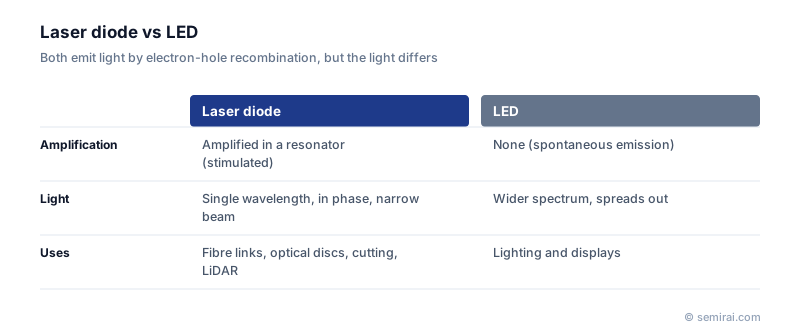
An LED relies on spontaneous emission, so its light spreads widely and covers a range of wavelengths. A laser diode adds a resonator and operates above a threshold current, where stimulated emission produces a narrow, coherent beam. That beam can be focused finely, which is why lasers are used for data transmission and optical storage.
Why can't laser diodes be made from silicon?
Silicon has an indirect bandgap, so electrons and holes rarely recombine by emitting light. Laser diodes use direct-bandgap compound semiconductors such as GaAs, InP and GaN. In silicon photonics the laser is usually a separate compound semiconductor chip attached to, or bonded onto, the silicon circuit.
Related pages
Sources
Last updated: November 1, 2026