Double-Sided Cooling
Double-sided cooling is a power module structure that removes heat from both the top and bottom faces of a power semiconductor chip. Metal plates bonded to the top of the chip replace bond wires, and coolers on both sides cut thermal resistance sharply, allowing more current or smaller chips.
Also called: dual-side cooling, DSC
Diagram
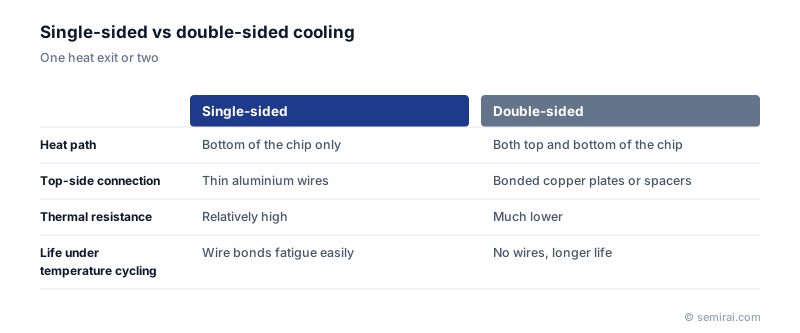
Single-sided vs double-sided cooling
In a conventional module, the bottom of the chip is soldered to an insulated substrate and base plate, which pass heat to the cooler. The top of the chip is connected only by thin aluminium bond wires, so almost all heat leaves through the bottom. This is single-sided cooling.
A double-sided module bonds a thick copper plate or spacer to the top of the chip as well, using solder or sintered silver, and cools both sides. With two heat exits, the thermal resistance from chip to coolant falls considerably. Removing the bond wires also removes a common wear-out failure, in which wire bonds crack and lift off after repeated temperature cycles. The shorter, wider current paths lower parasitic inductance as well.
Where it is used and how it is made
Automotive inverters adopted double-sided cooling early, because vehicles demand compact, high-power and long-lived power electronics. Interest has grown with electric vehicles and silicon carbide: SiC chips are small for their current rating and can run hot, so a lot of heat is concentrated in a small area and must be removed quickly.
Manufacturing is demanding. Both faces of the module must be flat and parallel to make good thermal contact with the coolers, and electrical insulation between the chip and the coolers must be maintained on both sides. Thermal expansion mismatch between chip, copper and insulator must also be managed.
Japanese companies involved
- Denso has mass-produced double-side-cooled power card modules for hybrid vehicle inverters since the 2000s.
- Mitsubishi Electric and Fuji Electric develop power modules for electric vehicle inverters, including structures with improved cooling and wire-free interconnects.
- Denso · Automotive power semiconductors, sensors and ICs
- Mitsubishi Electric (power devices) · IGBT and SiC power modules, RF and optical devices
- Fuji Electric (power semiconductors) · IGBT modules and SiC power devices
FAQ
Why is double-sided cooling important for SiC?
A SiC chip carries the same current in a smaller area than a silicon chip, so its heat flux is higher. Removing heat through both faces keeps the junction temperature down and lets the small chip be used at its full current capability.
Does double-sided cooling improve reliability as well as cooling?
Yes. Without bond wires, the most common power-cycling failure, wire bond lift-off, is avoided. Lower temperature swings also reduce fatigue in the remaining solder or sintered joints, extending module life.
Related pages
Sources
Last updated: November 2, 2026