Junction Temperature / Thermal Resistance
Junction temperature (Tj) is the temperature of the active region inside a semiconductor chip, where current flows and heat is generated. It is the most important temperature for device lifetime and failure. Thermal resistance (Rth) states how much the temperature rises per watt of heat flow, in °C/W or K/W.
Also called: Tj, Rth, Rth(j-c), thermal impedance
Diagram
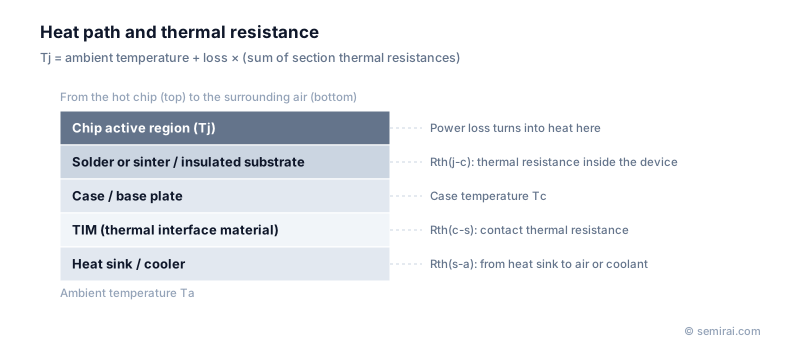
Estimating junction temperature
The junction cannot be measured directly from outside the package, yet datasheets give a maximum junction temperature that must not be exceeded. For silicon power devices this is typically 150 °C or 175 °C; SiC devices are being developed for higher limits.
Thermal resistance is split into sections along the heat path: junction to case, Rth(j-c); case to heat sink, Rth(c-s); and heat sink to ambient, Rth(s-a). The sections add up in series, and the basic estimate is Tj = ambient temperature + power loss × total thermal resistance. It is the same idea as Ohm's law, with heat flow in place of current and temperature difference in place of voltage. Detailed designs use thermal network models that also capture heat spreading and transient behaviour.
Lowering thermal resistance in power modules
Power module chips dissipate a lot of heat, so lower thermal resistance translates directly into higher current capability and better reliability. Common measures include insulated substrates of high-conductivity ceramics such as silicon nitride or aluminium nitride, replacing solder with sintered silver, better thermal interface materials (TIM) and double-sided cooling, which removes heat through both faces of the chip.
Temperature swings matter as much as peak temperature. Each heating and cooling cycle stresses bond wires and solder joints through differences in thermal expansion, eventually causing cracks. Keeping the swing in junction temperature small is therefore a central part of power-module lifetime design.
Japanese companies involved
- Mitsubishi Electric and Fuji Electric design power modules with low-thermal-resistance substrates and joining technologies to raise current density and power-cycling life.
- ROHM publishes thermal design application notes explaining thermal resistance and thermal characterisation parameters for its ICs and power devices.
- Mitsubishi Electric (power devices) · IGBT and SiC power modules, RF and optical devices
- Fuji Electric (power semiconductors) · IGBT modules and SiC power devices
- ROHM · SiC and silicon power devices, analog ICs
FAQ
How is junction temperature measured?
Indirectly, using an electrical parameter that changes with temperature. The forward voltage of a diode or the threshold voltage of a transistor is calibrated against temperature beforehand, then measured during or right after operation to infer the junction temperature.
What is the difference between Rth(j-c) and Rth(j-a)?
Rth(j-c) runs from the junction to the case surface and reflects the device itself. Rth(j-a) runs all the way to the surrounding air and depends heavily on the board and heat sink. Rth(j-c) is therefore used to compare power devices.
Related pages
Sources
Last updated: November 2, 2026