Normally-off (Enhancement Mode)
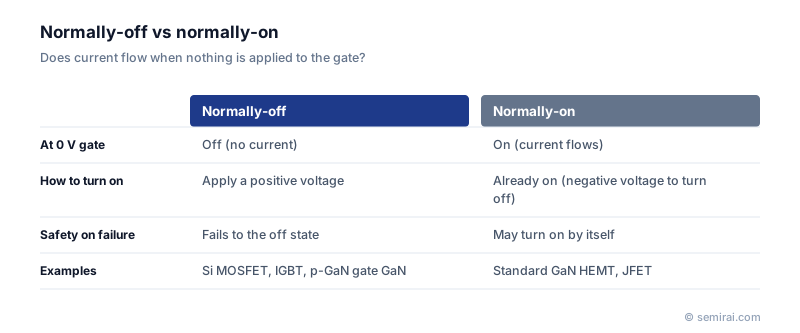
Normally-off describes a transistor that carries no current when no voltage is applied to its gate and turns on only when a positive gate voltage is applied. It is also called enhancement mode. The opposite, normally-on or depletion mode, conducts at zero gate voltage and needs a negative voltage to turn off.
Also called: enhancement mode, e-mode, normally-off transistor
Diagram
Why power circuits need normally-off devices
Silicon power MOSFETs and IGBTs are normally made as normally-off devices, and power circuits are designed around that behaviour for safety. If a gate driver fails, or the gate voltage is lost while a system is powering up or down, a normally-on device would turn on by itself. In a bridge circuit this can short the supply through both switches and destroy the equipment. A normally-off device fails safe: if anything goes wrong, current stops.
Making GaN normally-off
A gallium nitride high electron mobility transistor (GaN HEMT) is naturally normally-on. At the interface between AlGaN and GaN layers, polarization in the crystals creates a two-dimensional electron gas (2DEG) that forms the channel without any gate voltage.
The most widely used way to make it normally-off is the p-GaN gate: a p-type GaN layer under the gate depletes the 2DEG beneath it until a positive gate voltage is applied. Another approach is the cascode, in which a normally-on GaN HEMT is connected in series with a low-voltage silicon MOSFET that does the switching. A third is the recessed gate, where the barrier under the gate is etched thinner so the 2DEG disappears there. Each method trades off threshold voltage, gate drive range and ease of use.
Japanese companies involved
- ROHM makes enhancement-mode GaN HEMTs for power supplies.
- Renesas Electronics acquired Transphorm, a maker of GaN power devices that uses the cascode approach, in 2024.
- ROHM · SiC and silicon power devices, analog ICs
- Renesas Electronics · Microcontrollers, automotive SoCs, analog and power chips
FAQ
Why is a GaN HEMT normally-on?
When AlGaN is grown on GaN, spontaneous and piezoelectric polarization in the two materials gathers electrons at their interface, forming a two-dimensional electron gas. This conducting channel already exists at zero gate voltage, so a negative voltage is needed to switch it off.
What is the difference between p-GaN gate and cascode GaN?
A p-GaN gate makes the GaN device itself normally-off in a single chip, allowing very fast switching, but its gate needs a narrow, carefully controlled drive voltage. A cascode adds a silicon MOSFET that controls a normally-on GaN device, so it can be driven by a standard MOSFET gate driver.
Related pages
Sources
Last updated: November 2, 2026