Reverse Recovery
Reverse recovery is the brief reverse current that flows when a pn junction diode carrying forward current is suddenly reverse-biased. The duration is the reverse recovery time (trr), the charge removed is the reverse recovery charge (Qrr) and the peak is the reverse recovery current (Irr).
Also called: reverse recovery time (trr), reverse recovery charge (Qrr)
Diagram
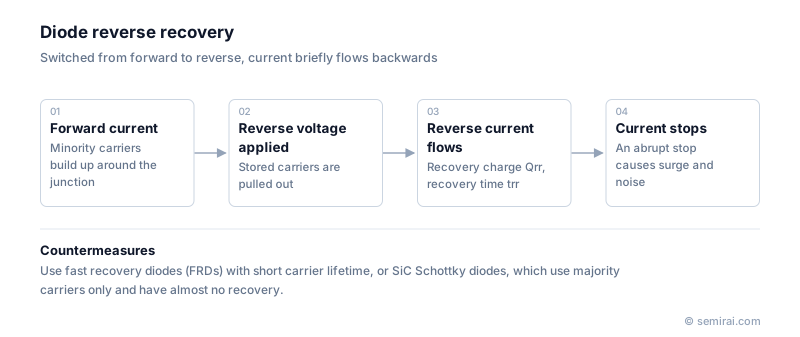
Why reverse recovery happens
While a pn diode conducts forward current, large numbers of minority carriers are stored around the junction. When the voltage reverses, the diode cannot block until these carriers have either recombined or been swept out as reverse current. Only then does the depletion region form and the current stop.
In a bridge circuit, this reverse current flows through the transistor that is turning on in the same leg. It therefore adds both to the diode's own loss and to the turn-on loss of the opposite switch. If the current stops abruptly, the parasitic inductance of the wiring produces a voltage overshoot and ringing, which also creates electromagnetic interference (EMI). Reverse recovery is thus a major source of loss and noise in inverters and switching power supplies.
How it is reduced
Fast recovery diodes (FRDs) shorten the minority-carrier lifetime so the stored charge disappears quickly. Lifetime is controlled by diffusing platinum or gold, or by irradiating the wafer with electrons, protons or helium ions. A soft recovery, in which the current falls gradually rather than snapping off, is as important as a short trr, because it limits overshoot.
Schottky barrier diodes work with majority carriers only, so in principle they have no stored minority charge and no reverse recovery; only the junction capacitance is charged. Silicon Schottky diodes are limited to low voltages, but silicon carbide Schottky diodes block 650 V and more with almost no recovery, which cuts inverter and PFC losses considerably. The reverse recovery of the body diode inside a MOSFET is another characteristic that bridge-circuit designers must watch.
Japanese companies involved
- ROHM makes SiC Schottky barrier diodes and fast recovery diodes for power supplies and inverters.
- Mitsubishi Electric and Fuji Electric design the freewheeling diodes in their IGBT modules for soft, low-loss recovery.
- ROHM · SiC and silicon power devices, analog ICs
- Mitsubishi Electric (power devices) · IGBT and SiC power modules, RF and optical devices
- Fuji Electric (power semiconductors) · IGBT modules and SiC power devices
FAQ
Why does reverse recovery get worse at high temperature?
Minority-carrier lifetime increases with temperature, so more charge is stored and it takes longer to remove. Qrr and trr of silicon pn diodes therefore rise noticeably when hot, while those of SiC Schottky diodes stay almost constant.
What is the difference between soft and snappy recovery?
In snappy recovery the reverse current falls to zero very abruptly, and the high di/dt across stray inductance causes large voltage spikes and ringing. In soft recovery the current decays gradually. Soft recovery gives lower EMI and less stress on the devices.
Related pages
- Diode
- Schottky Barrier Diode (SBD)
- Body Diode
- Switching Loss
- IGBT (Insulated Gate Bipolar Transistor)
- Super Junction MOSFET
- SiC MOSFET (Silicon Carbide MOSFET)
- Carrier Recombination
- Power semiconductor manufacturing equipment
- SiC power semiconductor equipment
- Advantest EXAVIS
- Advantest MT100 / MT200
- Hitachi High-Tech M-600 / 6000 series
- HORIBA MiPLATO-SiC
Sources
Last updated: November 13, 2026