Freewheeling Diode (FWD)
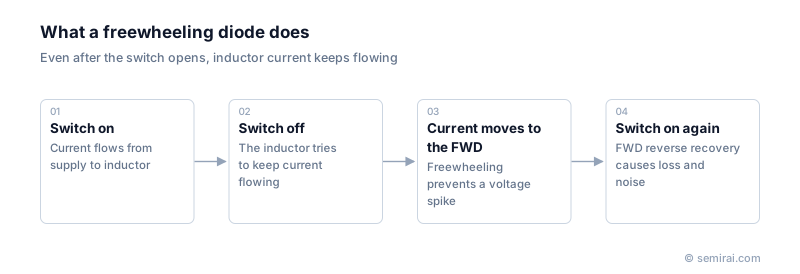
A freewheeling diode (FWD) gives the current in an inductor, such as a motor winding, a path to keep flowing when a switch turns off. Without it, the inductor would force the voltage up and could destroy the switch. The diode lets the current circulate, or freewheel, and so prevents the voltage spike.
Also called: FWD, flyback diode, free-wheeling diode
Diagram
FWDs in inverters and power modules
In an inverter, a freewheeling diode is connected in antiparallel with each IGBT or MOSFET, so that every switch position has a path for reverse current. An IGBT cannot conduct in the reverse direction, so a separate diode is essential. Inside an IGBT power module, IGBT chips and FWD chips therefore sit side by side in pairs.
With a MOSFET, the body diode that forms naturally inside the structure can act as the freewheeling diode. Some designs still add an external diode when the body diode is too slow or too lossy.
Why reverse recovery matters
The key characteristic of an FWD is reverse recovery. When the opposite switch turns on and the diode is suddenly reverse-biased, stored charge makes it conduct backwards for a short time. That current adds loss in both the diode and the switch, and its abrupt end causes voltage overshoot and electromagnetic noise.
Fast recovery diodes (FRDs), whose carrier lifetime has been shortened, are therefore used, preferably with soft recovery characteristics. Silicon carbide Schottky barrier diodes go further: they have almost no reverse recovery and are used to cut losses in high-efficiency inverters and power supplies. Another approach is the reverse-conducting IGBT (RC-IGBT), which integrates the IGBT and the freewheeling diode on a single chip.
Japanese companies involved
- Mitsubishi Electric and Fuji Electric make IGBT modules in which IGBT and FWD chips are designed together, as well as modules that use SiC diodes.
- ROHM makes SiC Schottky barrier diodes and fast recovery diodes used as freewheeling diodes.
- Mitsubishi Electric (power devices) · IGBT and SiC power modules, RF and optical devices
- Fuji Electric (power semiconductors) · IGBT modules and SiC power devices
- ROHM · SiC and silicon power devices, analog ICs
FAQ
Does a MOSFET need a separate FWD?
Often not, because its body diode can serve as the freewheeling diode. However, body diodes can recover slowly and have high conduction loss, so in high-efficiency circuits an external SiC Schottky barrier diode is sometimes connected in parallel.
Is an FWD the same as a flyback diode?
They do the same job: provide a path for inductor current. The term flyback diode is common for a diode placed across a relay or solenoid coil, while freewheeling diode is usual in inverters and motor-drive power circuits.
Related pages
Sources
Last updated: November 2, 2026