Silver Sintering
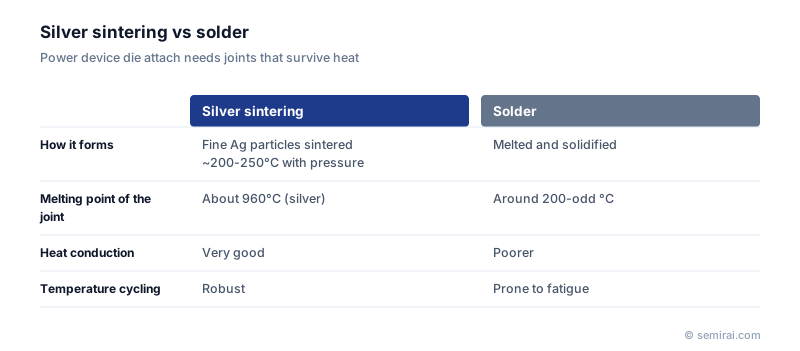
Silver sintering is a die attach method in which a paste or film of nano- or micro-sized silver particles is placed between a die and its substrate and heated, usually with pressure, at roughly 200-300°C. The particles fuse into a dense silver layer without melting, forming a joint with high thermal conductivity that withstands far higher temperatures than solder.
Also called: Ag sintering, sintered silver die attach, low-temperature joining technique
Diagram
Why power devices need it
Very small particles have a large surface area and sinter, joining at their contact points, far below the melting point of bulk silver, which is about 962°C. Once formed, the joint behaves like porous silver: it conducts heat and electricity much better than solder and does not melt at any operating temperature.
Power modules made with silicon carbide (SiC) MOSFETs or IGBTs switch large currents and heat up and cool down repeatedly. Solder layers under the chip fatigue and crack under this power cycling, and SiC devices can run at temperatures close to where common solders weaken. Sintered silver keeps its strength, so it extends module life and allows higher operating temperatures. It is widely used in inverters for electric vehicles.
Process challenges
Pressure-assisted sintering gives dense joints but needs presses that apply uniform force without cracking the die. Pressureless pastes are easier to use but more porous. The bonded surfaces need suitable metallisation, often silver or gold, and voids or uneven density must be controlled.
Silver is expensive, and the process is slower than solder reflow, so cost is a barrier. Sintered copper is being studied as a cheaper alternative. Silver sintering is often combined with copper clips or thick copper wires on the top side, to remove aluminium wire bonds, another weak point of power modules.
Japanese companies involved
- Japanese university research, including work at Osaka University, has studied the high-temperature reliability of sintered silver joints for wide-bandgap power modules.
- Namics · Underfill and die attach materials
FAQ
How does silver sintering compare with solder?
Solder melts and solidifies at a fixed temperature, usually around 200-250°C for lead-free alloys, so it softens near the operating temperature of power devices. Sintered silver forms below its melting point and then stays solid up to the melting point of silver, with several times better thermal conductivity.
Is pressure always needed?
No. Pressureless sintering pastes exist and are easier to use in production, but pressure-assisted sintering generally gives denser, stronger joints. The choice depends on the reliability required and the production equipment.
Related pages
- Die Bonding (Die Attach)
- SiC MOSFET (Silicon Carbide MOSFET)
- Power Module
- IGBT (Insulated Gate Bipolar Transistor)
- Thermal Interface Material (TIM)
- Double-Sided Cooling
- Void (Packaging Defect)
- Die bonders
- Fasford Technology DB850 Series
- Fasford Technology DD100 Series
- Fasford Technology XERDIA
- Shibuya Corporation FDB250
Sources
Last updated: November 13, 2026