Integrated Circuit (IC)
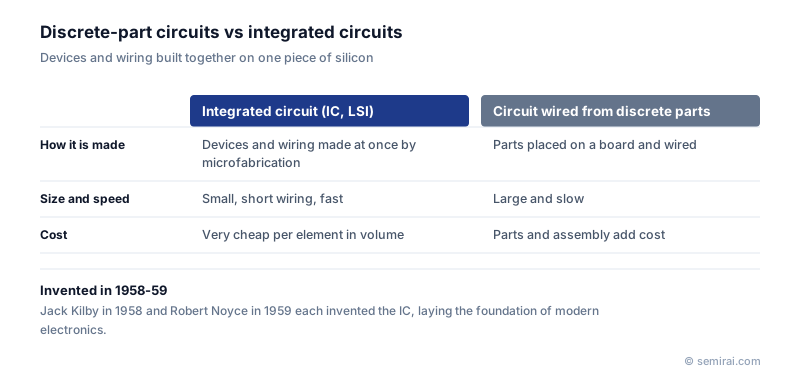
An integrated circuit (IC) is a device in which many circuit elements, such as transistors, diodes, resistors and capacitors, are built together with their wiring on a single chip of silicon or another semiconductor. Invented in 1958-59, it replaced circuits wired from separate parts and became the foundation of modern electronics.
Also called: IC, chip, microchip, LSI
Diagram
Origins and scaling
Jack Kilby at Texas Instruments demonstrated the first integrated circuit in 1958, and Robert Noyce at Fairchild Semiconductor invented a planar version in 1959 that could be mass-produced. Building every element and connection in one process made circuits smaller, faster and far cheaper per element than assembling discrete parts.
For decades the number of transistors on a chip roughly doubled every two years, the trend known as Moore's law. Intel's first microprocessor, the 4004 of 1971, had about 2,300 transistors. Today's largest processors contain tens of billions, and that growth has delivered both more performance and lower cost per function.
Types of IC
Logic ICs such as CPUs, GPUs, FPGAs and ASICs perform computation. Memory ICs such as DRAM, NAND flash and SRAM store data. Analog ICs, including amplifiers, data converters and power management chips, handle real-world signals and supply voltages, while mixed-signal and RF chips combine both worlds.
Most advanced chips are now systems-on-chip (SoC) that combine CPU and GPU cores, memory controllers, AI accelerators and communication blocks. Integration is also moving into the package, where chiplets and stacked memory are combined side by side or on top of each other.
Japanese companies involved
- Renesas Electronics is a major maker of microcontrollers and automotive SoCs, and Kioxia makes NAND flash memory.
- Rapidus is developing 2 nm logic manufacturing in Hokkaido.
- Renesas Electronics · Microcontrollers, automotive SoCs, analog and power chips
- Kioxia · NAND flash memory and SSDs
- Rapidus · Leading-edge logic foundry (2 nm, in development)
FAQ
What is the difference between IC and LSI?
They describe the same thing at different scales. LSI (large-scale integration) and VLSI (very-large-scale integration) were historical labels for chips with more elements. LSI is still common in Japanese usage, while English usage mostly says IC or chip.
How is an IC made?
Thin films are repeatedly deposited, patterned by lithography, etched and doped on a silicon wafer to form transistors and wiring. The finished wafer is tested, cut into dies, and each die is packaged and tested again.
Who designs and who manufactures ICs?
Some companies do both, but many designers are fabless: they design chips with EDA tools and have them made by foundries. Packaging and test are often handled by specialist outsourced companies.
Related pages
Sources
Last updated: November 2, 2026