Flowable CVD (FCVD)
Flowable CVD (FCVD) is a deposition method that forms a film which flows like a liquid immediately after deposition, so it fills narrow, deep trenches from the bottom, and then converts it into solid silicon oxide by curing. Unlike conventional CVD, which coats along the trench walls, it can fill high-aspect-ratio gaps without voids or seams.
Also called: FCVD, flowable chemical vapour deposition
Diagram
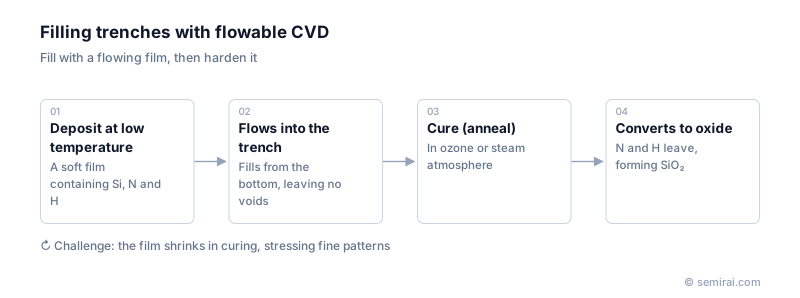
How FCVD works
In a common approach, a silicon- and nitrogen-containing precursor reacts on a cool wafer with reactive species produced in a remote plasma. This creates a soft, uncured film of silicon, nitrogen and hydrogen that flows into trenches, driven in part by capillary forces, filling them from the bottom up.
The wafer is then cured in an atmosphere containing ozone or steam. Nitrogen and hydrogen leave the film and oxygen takes their place, turning it into silicon dioxide. Further anneals densify the oxide. The idea is close to spin-on glass, in which a liquid is coated and baked, but carried out from the gas phase in a vacuum chamber.
Where it is used and what is hard
FCVD came into use around 2010 for shallow trench isolation at the 20 nm generation and beyond. Its role has grown as gaps became narrower and deeper: between FinFET fins, in the deep slits of 3D NAND and in fine DRAM patterns.
The main problems are shrinkage during cure, because removing nitrogen and hydrogen reduces volume, and differences in film quality between the bottom and the top of a trench. Shrinkage stresses the surrounding structures and can bend or collapse thin lines, so cure temperature and atmosphere are adjusted in stages.
Japanese companies involved
- Tokyo Electron (TEL) · Coat/develop, etch and deposition equipment
FAQ
How does FCVD differ from spin-on glass?
Both fill gaps with a material that flows and then cure it into oxide. SOG is a liquid spun onto the wafer, whereas FCVD forms the flowing film from gases in a vacuum chamber. FCVD gives finer control of thickness and composition and fits into the same tool sets as other deposition steps.
Why does the film shrink during curing?
The as-deposited film contains a lot of nitrogen and hydrogen. During curing these leave and are replaced by oxygen to form a dense oxide network, and the volume decreases. Gradual, staged curing limits the stress this places on narrow features.
What else is used for gap fill?
High-density-plasma CVD, which deposits and sputters at the same time, and sub-atmospheric CVD with TEOS and ozone were standard before FCVD. ALD-based fill and spin-on dielectrics are other options, chosen according to gap width, depth and the temperature the device can tolerate.
Related pages
Sources
Last updated: November 2, 2026