HKMG (High-k Metal Gate)
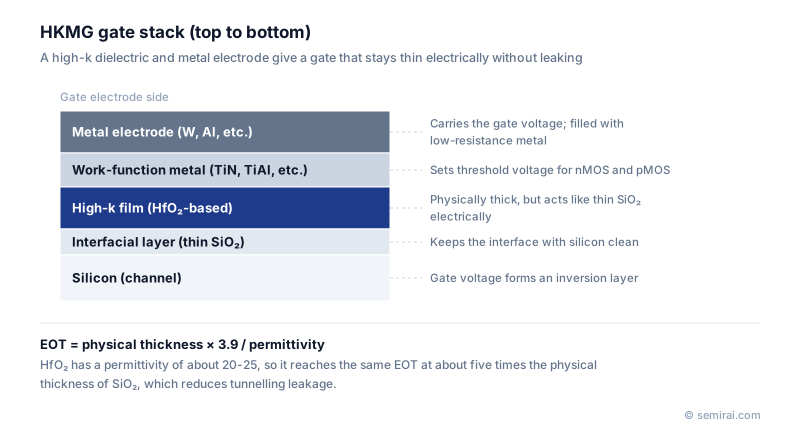
HKMG (high-k metal gate) is the gate technology that uses a high-permittivity dielectric, mainly HfO₂-based, as the gate insulator and metal layers such as TiN as the gate electrode. Intel introduced it in volume production at the 45 nm node in 2007, and it is now standard in advanced logic.
Also called: high-k/metal gate, HK/MG
Diagram
The two problems HKMG solved
The first was gate leakage. Silicon dioxide gate oxides had been thinned to around 1.2 nm, where direct tunnelling current rises steeply, wasting power and heating the chip. HfO₂, with k around 20-25, gives the same capacitance at roughly five to six times the physical thickness, so tunnelling falls sharply.
The second was the polysilicon electrode. Polysilicon on high-k films suffers Fermi-level pinning, which fixes the threshold voltage at unwanted values, and polysilicon depletion adds an extra series capacitance. A metal electrode has no depletion, and choosing different work-function metals for n-type and p-type transistors lets designers set each threshold voltage.
Gate-first and gate-last
In a gate-first flow the high-k and metal gate are formed before the source and drain are activated by a high-temperature anneal, which can shift the metal's work function. In a gate-last flow, also called replacement metal gate, a dummy polysilicon gate is used during the hot steps and is then removed and replaced with the high-k/metal stack.
Intel's 45 nm process used a gate-last approach, while the IBM-led alliance used gate-first at 32 and 28 nm before the industry converged on gate-last. FinFET and gate-all-around processes today use gate-last.
HKMG in gate-all-around transistors
In nanosheet transistors the gate wraps all four sides of each stacked sheet, so the high-k layer and several metal layers must be deposited by atomic layer deposition into gaps only a few nanometres wide and then filled without voids. Gate fill and work-function tuning have become some of the hardest steps in leading-edge logic.
Japanese companies involved
- Tokyo Electron supplies deposition and etch equipment used in gate-stack formation, including ALD systems.
- Tokyo Electron (TEL) · Coat/develop, etch and deposition equipment
FAQ
What are the disadvantages of HKMG?
It adds process steps and cost: several ALD layers, separate work-function metals for n- and p-type devices, and in gate-last flows an extra dummy gate removal and CMP. Defects at the high-k/metal and high-k/silicon interfaces must also be controlled tightly.
Which metals are used in an HKMG stack?
Titanium nitride and tantalum nitride are common barrier and work-function layers, aluminium-containing compounds such as TiAl or TiAlC lower the work function for n-type devices, and a low-resistance fill metal such as tungsten or aluminium completes the electrode.
Related pages
Sources
Last updated: November 2, 2026