ALD (Atomic Layer Deposition)
ALD (atomic layer deposition) is a thin-film method that builds a film through repeated cycles of self-limiting surface reactions. Each precursor stops reacting once it has covered the surface, so every cycle adds a fixed amount, typically 0.3-2 Å, and the thickness is set simply by the number of cycles.
Also called: atomic layer deposition, PEALD, plasma-enhanced ALD
Diagram
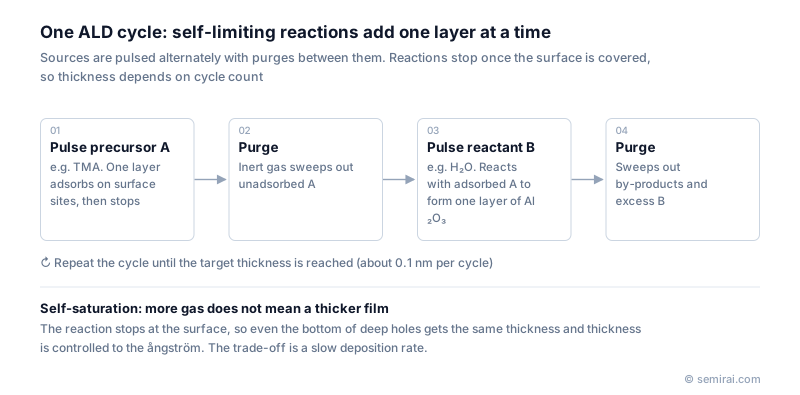
How an ALD cycle works
A basic cycle has four steps. Precursor A, for example trimethylaluminium (TMA), is pulsed in and chemisorbs on the surface until every reactive site is used. An inert gas purge removes the excess. Reactant B, for example water, is pulsed in and reacts with the adsorbed layer to form the film, here aluminium oxide. A second purge removes by-products.
Because bulky precursor molecules shield neighbouring sites, the growth per cycle is usually less than a full atomic layer; for Al₂O₃ from TMA and water and for hafnium oxide it is about 1 Å. The method grew out of atomic layer epitaxy, developed by Tuomo Suntola and colleagues in Finland in the 1970s.
Why ALD matters for 3D devices
Since each precursor saturates the entire surface, the sidewalls and bottoms of deep holes and trenches receive almost the same thickness as the top. This conformality is hard to reach with chemical or physical vapour deposition and is essential for 3D NAND, FinFETs and gate-all-around nanosheets.
Typical ALD films include high-k dielectrics such as HfO₂ and ZrO₂ for logic gates and DRAM capacitors, TiN and TaN for barriers and gate electrodes, Al₂O₃ for blocking and passivation layers, and SiO₂ or SiN for spacers in multiple patterning. Thermal ALD usually runs at about 150-400°C, while plasma-enhanced ALD (PEALD) activates the reactant with a plasma and can work at lower temperatures, which suits temperature-sensitive layers.
Japanese companies involved
- Tokyo Electron supplies ALD and other deposition systems for logic and memory production.
- Kokusai Electric makes batch ALD systems that coat many wafers at once in a vertical furnace, a format widely used for memory.
- Tokyo Electron (TEL) · Coat/develop, etch and deposition equipment
- Kokusai Electric · Batch deposition, diffusion and ALD equipment
- ULVAC · Vacuum deposition (sputtering) equipment and vacuum pumps
FAQ
Why is ALD slow?
Each cycle needs two precursor pulses and two purges, and every cycle adds only about a tenth of a nanometre. A 10 nm film may therefore take around a hundred cycles. Batch reactors and spatial ALD, which moves the wafer between gas zones, are used to raise throughput.
Does flowing more precursor make the film thicker?
No. Once the surface sites are saturated the reaction stops, so extra precursor is simply purged away. This self-saturation is what makes the thickness depend only on the cycle count and makes the coating uniform even in deep holes.
What limits the films ALD can make?
A suitable pair of precursors must exist that react cleanly within a usable temperature window without decomposing on their own. Impurities such as carbon or chlorine from the precursor ligands can remain in the film, so precursor chemistry is an active field of development.
Comparisons
Related pages
- Deposition
- CVD (Chemical Vapour Deposition)
- Atomic Layer Etching (ALE)
- Step Coverage
- Precursor
- Area-Selective Deposition (ASD)
- Barrier Metal (Diffusion Barrier)
- High-k Dielectric
- ALD equipment
- Kokusai Electric Advanced TSURUGI
- Kokusai Electric Advanced TSURUGI Plus-Ⅲ
- Kokusai Electric TSURUGI-C²®
- Tokyo Electron (TEL) NT333™
Sources
Last updated: November 2, 2026