Functional Water
Functional water is ultrapure water in which a small amount of gas, such as hydrogen, ozone or carbon dioxide, is dissolved, or a trace of chemical is added, to give it a specific cleaning function. It was developed, largely by research in Japan in the 1990s, to replace part of the concentrated-chemical cleaning such as RCA cleaning and to reduce chemical use, water use and waste.
Also called: hydrogen water, ozonated water, carbonated water, CO₂ water
Diagram
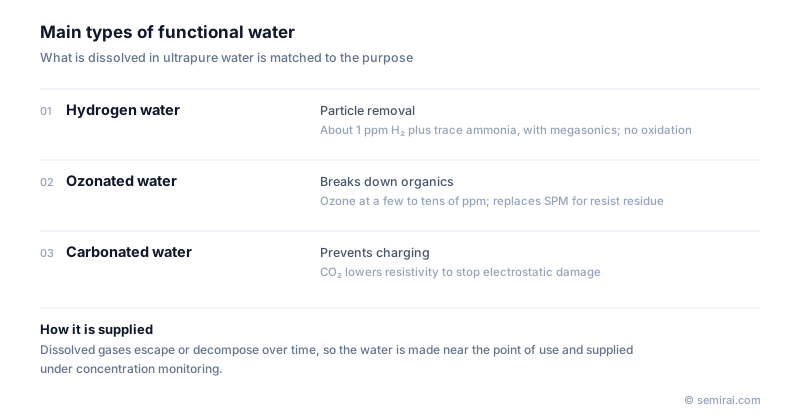
Main types
Hydrogen water contains dissolved hydrogen at around 1 ppm. With a trace of ammonia and megasonic agitation it removes particles efficiently without oxidising the wafer surface.
Ozonated water contains dissolved ozone at a few to a few tens of ppm. Its strong oxidising power decomposes organic matter, so it is used to remove resist residues and organics in place of the sulphuric acid and peroxide mixture (SPM).
Carbonated water contains dissolved carbon dioxide, which lowers the electrical resistivity of ultrapure water. It is widely used as rinse water to prevent electrostatic charging of spinning wafers and the resulting device damage.
Making and supplying it
Dissolved gases escape or decompose over time, so functional water is made on site and delivered close to the point of use. Generators that hold the concentration steady and in-line concentration monitors are essential. The equipment is typically combined with single-wafer cleaning tools.
Japanese companies involved
- Kurita Water Industries supplies functional water equipment alongside its ultrapure water systems.
- Organo supplies ultrapure water systems and functional water equipment for semiconductor fabs.
- Kurita Water Industries · Ultrapure water systems and wastewater treatment
- Organo · Ultrapure water systems, water recycling and functional water
- Nomura Micro Science · Ultrapure water systems
FAQ
What is the benefit of functional water?
It replaces some cleaning that would otherwise use large volumes of concentrated chemicals. That reduces chemical and water consumption, the load on waste treatment and safety risks for workers, while keeping cleaning performance.
Why is carbonated water used for rinsing?
Ultrapure water conducts almost no electricity, so friction between a spinning wafer and the water can build up static charge that damages devices. Dissolved carbon dioxide lowers resistivity enough for the charge to leak away, preventing that damage.
Related pages
Sources
Last updated: November 13, 2026