Ultrapure Water (UPW)
Ultrapure water (UPW) is water purified until almost nothing but H₂O remains: its resistivity approaches the theoretical 18.2 MΩ·cm at 25°C, total organic carbon is below about 1 ppb, and metal ions are at ppt levels. Fabs use it in very large volumes to rinse wafers and dilute chemicals.
Also called: UPW, ultra-pure water
Diagram
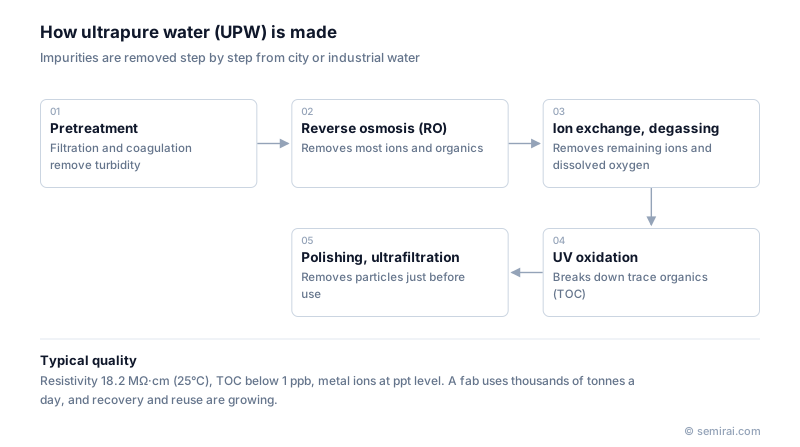
How UPW is made
A UPW plant works in stages. Pretreatment removes suspended solids and some organics by coagulation, filtration and activated carbon. The primary system uses reverse osmosis (RO) membranes and ion-exchange resins to strip out most ions. The secondary or polishing system uses ultraviolet light at 185 nm to break down remaining organic carbon, membrane degassing to remove dissolved oxygen, further ion exchange and ultrafiltration.
A final ultrafilter and polisher sit close to where the water is used, because water quality can fall again in long distribution pipes. Much of the used rinse water is collected, treated and recycled.
Why purity matters
Every rinse leaves a thin film of water on the wafer. Particles, metals, silica or organics in that water stay on the surface after drying and can raise leakage, damage gate insulators or shorten carrier lifetime. As features shrink, the tolerable levels of these impurities fall.
UPW supply is also a production risk. A broken membrane, contaminated pipe or exhausted resin bed can stop wafer processing at once, so systems are built with redundant trains and continuous online monitoring of resistivity, organic carbon, particles and dissolved oxygen.
Japanese companies involved
- Kurita Water Industries, Organo and Nomura Micro Science design and build ultrapure water systems for semiconductor fabs.
- Tokyo Electron and SCREEN Holdings make wet cleaning tools that are among the largest users of UPW in a fab.
- Kurita Water Industries · Ultrapure water systems and wastewater treatment
- Organo · Ultrapure water systems, water recycling and functional water
- Nomura Micro Science · Ultrapure water systems
- SCREEN Holdings · Wafer cleaning, coat/develop and inspection equipment
- Tokyo Electron (TEL) · Coat/develop, etch and deposition equipment
FAQ
Why is 18.2 MΩ·cm the limit for water resistivity?
Even perfectly pure water contains a tiny number of hydrogen and hydroxide ions from its own dissociation. At 25°C these set the resistivity of pure water at about 18.2 MΩ·cm, so a reading close to that value means almost no other ions are present.
Is UPW safe to drink?
It is not toxic, but it is not meant for drinking. It has no minerals, it readily dissolves material from containers, and in a fab it is handled in systems that are not designed for food use.
Related pages
Sources
Last updated: November 2, 2026