Photovoltaic Effect
The photovoltaic effect is the generation of a voltage when light falls on a material. In a semiconductor pn junction, absorbed light creates electron-hole pairs, and the built-in field of the depletion region drives electrons to the n side and holes to the p side. A voltage appears across the junction, and current flows if a circuit is connected.
Also called: photovoltaic action
Diagram
Conditions and key quantities
Only photons with more energy than the bandgap, that is with short enough wavelength, can create carriers. The carriers must then reach the junction field before they recombine, so carrier lifetime, diffusion length and surface passivation determine how efficient a device is. The effect was first observed in 1839 by Edmond Becquerel using electrodes in an electrolyte.
Two numbers describe a solar cell. The open-circuit voltage is measured with no load connected, and the short-circuit current flows when the terminals are joined. A silicon cell has an open-circuit voltage of about 0.6 to 0.7 V.
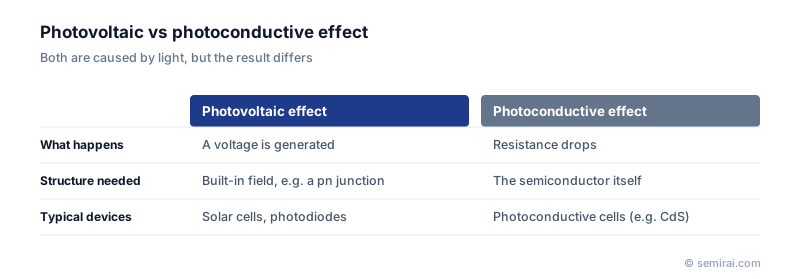
Photovoltaic vs photoconductive effect
In the photoconductive effect, light-generated carriers raise a material's conductivity, but no voltage is produced on its own; an external voltage is needed to read the change as current. Cadmium sulfide (CdS) light sensors, or photoresistors, are a common example.
Photodiodes can be used either way. With no bias they work in photovoltaic mode, like a small solar cell. With reverse bias they work in photoconductive mode, where the wider depletion region gives a faster response, which suits optical communication receivers and image sensors.
Japanese companies involved
- Hamamatsu Photonics makes silicon and InGaAs photodiodes and other light sensors based on this effect.
- Hamamatsu Photonics · Failure analysis, process monitoring and static elimination equipment
FAQ
What sets the open-circuit voltage of a solar cell?
It depends mainly on the bandgap and on how strongly carriers recombine. A wider bandgap allows a higher voltage, and less recombination brings the voltage closer to that limit. Modules reach practical voltages by wiring many cells in series.
Does a photodiode need a power supply?
Not necessarily. In photovoltaic mode it generates its own signal with no bias, which gives low noise and suits precise light measurement. For high-speed detection a reverse bias is applied, which lowers capacitance and speeds up the response.
Related pages
Sources
Last updated: November 2, 2026