Schottky Barrier Diode (SBD)
A Schottky barrier diode (SBD) is a diode that uses the potential barrier formed where a metal meets a semiconductor, called a Schottky barrier. Unlike a pn junction diode, it conducts with majority carriers only, so its forward voltage drop is small and it switches very fast, with almost no reverse recovery.
Also called: Schottky diode, SBD, SiC Schottky diode
Diagram
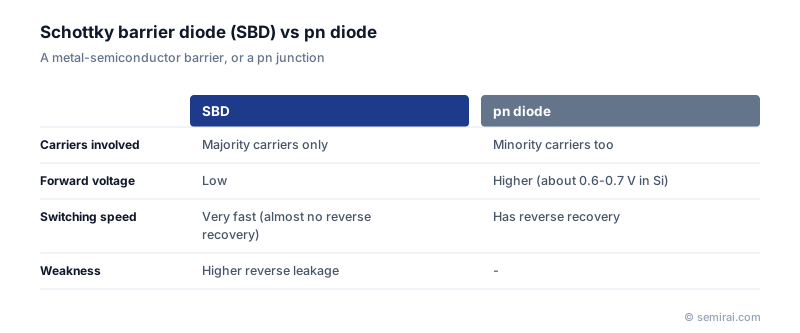
How it differs from a pn diode
In a pn diode, forward current injects minority carriers that are stored in the device and must be swept out when it turns off. This produces a reverse recovery current and switching losses. In a Schottky diode, current is carried by majority carriers crossing the metal-semiconductor barrier, so there is essentially no stored charge and turn-off is almost instantaneous.
The barrier height depends on the metal and the semiconductor, and is also affected by Fermi-level pinning at the interface. Low-voltage silicon SBDs typically have forward voltages of a few tenths of a volt, lower than the 0.6 to 0.7 V of a silicon pn diode, which cuts conduction losses in rectifiers.
Weaknesses and the SiC answer
The trade-off is higher reverse leakage, which also increases strongly with temperature, and difficulty reaching high reverse voltages. Silicon SBDs are therefore mostly used up to around 100 to 200 V, in switching power supplies, DC-DC converters, reverse-polarity protection and high-frequency circuits.
Silicon carbide (SiC) changed this. Its wide band gap and high breakdown field allow Schottky diodes rated at 600 V, 1,200 V and above while keeping fast, nearly loss-free switching. SiC SBDs are now standard in power factor correction circuits, solar inverters, server power supplies and electric vehicle chargers and inverters.
Japanese companies involved
- ROHM makes silicon Schottky barrier diodes and SiC Schottky barrier diodes for power applications, and Toshiba Electronic Devices & Storage also makes silicon and SiC SBDs.
- Toshiba Electronic Devices & Storage · Power MOSFETs, IGBTs and discrete semiconductors
- ROHM · SiC and silicon power devices, analog ICs
FAQ
Why are Schottky diodes used in switching power supplies?
Their low forward voltage reduces conduction loss, and their lack of reverse recovery reduces switching loss and electrical noise. Both matter at the high frequencies used in modern power supplies.
Is every metal-semiconductor contact a Schottky diode?
No. If the semiconductor is very heavily doped, the barrier becomes thin enough for electrons to tunnel through in both directions, giving a low-resistance ohmic contact. Chip contacts are designed this way, while SBDs use lightly doped semiconductor.
What is a JBS diode?
A junction barrier Schottky (JBS) diode adds small p-type regions under the Schottky contact. Under reverse bias they pinch off the area under the metal and reduce leakage, a structure widely used in SiC Schottky diodes.
Related pages
Sources
Last updated: November 2, 2026