Carrier Recombination
Carrier recombination is the process in which a free electron in a semiconductor falls from the conduction band into a hole in the valence band, so that both carriers disappear. The energy released leaves as light or as heat. Recombination produces the light of LEDs and lasers, but in solar cells, photodetectors and many transistors it is a loss to be minimised.
Also called: recombination, electron-hole recombination
Diagram
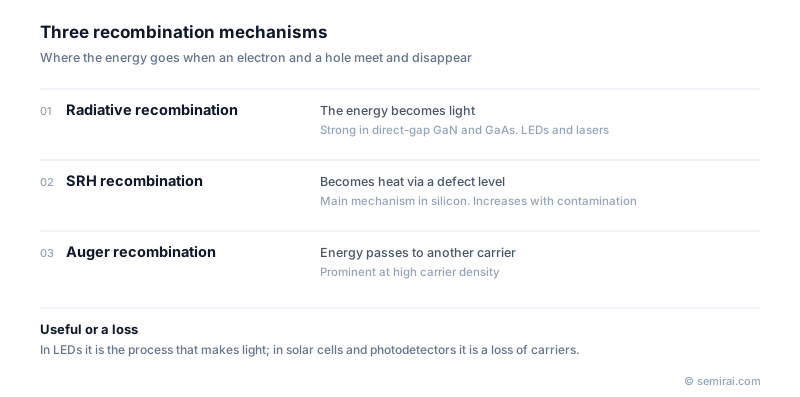
Three recombination mechanisms
In radiative recombination an electron and hole meet directly and emit a photon with an energy close to the band gap. It is efficient only in direct-gap semiconductors such as GaAs and GaN, where the electron needs no change of momentum. In indirect-gap silicon, a photon alone cannot conserve momentum, so radiative recombination is very weak.
Shockley-Read-Hall (SRH) recombination proceeds in two steps through an energy level inside the band gap, created by a crystal defect or an impurity such as iron or gold. The energy is released as lattice vibrations, that is heat. SRH is the dominant mechanism in most silicon devices, and its rate rises with the density of defects and metal contamination.
In Auger recombination the energy is handed to a third carrier, which then loses it as heat. Because three carriers are involved, it grows rapidly with carrier density and dominates in heavily doped regions and at high injection, for example in power devices conducting large currents.
Lifetime and its control
The average time an excess carrier survives before recombining is the carrier lifetime, and the distance it diffuses in that time is the diffusion length. Lifetime is a sensitive measure of crystal quality: wafer makers and fabs measure it, for example by microwave photoconductance decay, to detect metal contamination.
Sometimes engineers want short lifetime. In fast-recovery diodes and IGBTs, stored carriers must disappear quickly when the device turns off, so recombination centres are introduced deliberately by platinum diffusion, electron irradiation or proton irradiation. The trade-off is a higher on-state voltage.
Where it helps and where it hurts
LEDs and laser diodes depend on radiative recombination, and the emitted colour follows the band gap of the active layer. Solar cells and image sensors need the opposite: carriers generated by light must be collected before they recombine, which is why surface passivation and clean, low-defect silicon raise their efficiency. Generation, the reverse process, also matters: defect levels that speed recombination also generate leakage and dark current.
FAQ
Why does silicon not emit light efficiently?
Silicon has an indirect band gap: the lowest conduction-band states and the highest valence-band states sit at different crystal momenta. An electron and hole can recombine radiatively only with help from a phonon, which is unlikely, so non-radiative SRH recombination at defects wins almost every time.
Is recombination always bad for transistors?
In MOSFETs and memory it mainly appears as leakage, because the same defect levels that cause recombination also generate carriers. In bipolar transistors, recombination in the base lowers current gain. In power diodes and IGBTs, however, controlled recombination is needed for fast switching.
What sets the colour of an LED?
The photon energy is close to the band gap of the light-emitting layer. Engineers tune it by alloy composition, for example the indium content of InGaN for blue and green or AlGaInP for red. A shorter wavelength requires a wider band gap.
Related pages
Sources
Last updated: November 2, 2026