Rate-Limiting Step
A rate-limiting step is the slowest of several processes that must happen in sequence, and it sets the speed of the whole. However fast the other steps are, the overall process cannot run faster than this bottleneck. The idea comes from chemical kinetics and is basic to understanding deposition, oxidation and diffusion in chipmaking.
Also called: rate-determining step, reaction-limited regime, supply-limited regime
Diagram
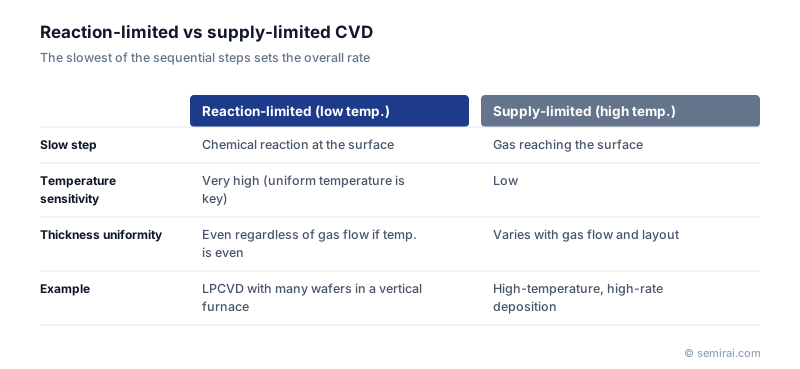
Reaction-limited and supply-limited CVD
In chemical vapour deposition (CVD), two steps happen in series: reactant gas is carried to the wafer surface, and it then reacts there to form the film. At low temperature the surface reaction is slow and limits the rate. The deposition rate then depends strongly on temperature but hardly on gas flow, so films come out uniform across many wafers and conformal inside fine features.
At high temperature the reaction becomes fast and the gas supply can no longer keep up. The process becomes supply-limited, also called diffusion-limited or mass-transport-limited. The rate then depends on gas flow and reactor geometry and much less on temperature. This is why low-pressure CVD (LPCVD) in batch furnaces, which stacks many wafers close together, is run in the reaction-limited regime.
The same shift in thermal oxidation
Thermal oxidation of silicon also changes its limiting step. While the oxide is thin, the reaction at the silicon surface limits growth and thickness increases roughly in proportion to time (the linear regime). As the oxide thickens, oxygen has to diffuse through it to reach the interface, diffusion becomes the bottleneck, and thickness grows roughly with the square root of time (the parabolic regime).
Engineers often find the limiting step by measuring the rate at several temperatures and drawing an Arrhenius plot. A change in the slope shows where the process switches from one regime to the other.
Japanese companies involved
- Kokusai Electric and Tokyo Electron make vertical batch furnaces used for LPCVD, oxidation and diffusion, where process conditions are chosen around these regimes.
- Kokusai Electric · Batch deposition, diffusion and ALD equipment
- Tokyo Electron (TEL) · Coat/develop, etch and deposition equipment
FAQ
Why does reaction-limited deposition give more uniform films?
When the surface reaction is the bottleneck, reactant gas is available everywhere in excess, so small differences in flow do not change the local rate. Only temperature matters, and a furnace can hold temperature very evenly. The gas also has time to reach the bottom of trenches before reacting, which improves step coverage.
Is a supply-limited process always worse?
No. Supply-limited conditions give high deposition rates and are less sensitive to small temperature variations. They suit single-wafer reactors with carefully designed gas flow, such as some epitaxial growth processes, where speed matters and the flow can be controlled uniformly.
Related pages
Sources
Last updated: November 2, 2026