Pirani Gauge
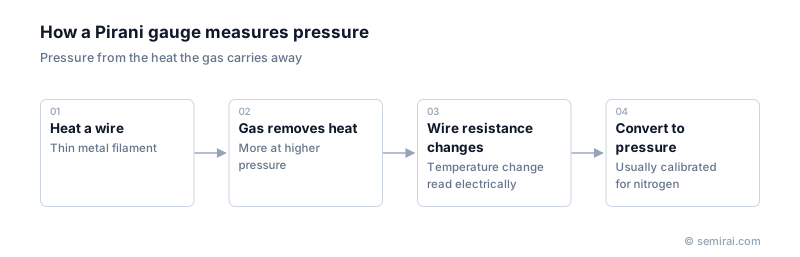
A Pirani gauge is a vacuum gauge that heats a thin metal wire with an electric current and measures pressure from how much heat the surrounding gas carries away. The more gas molecules there are, the more heat they remove, so the wire cools and its resistance changes. It was invented by the physicist Marcello Pirani in 1906 and is the classic thermal-conductivity gauge.
Also called: thermal conductivity gauge
Diagram
Range and uses
A Pirani gauge covers roughly 0.1 Pa up to near atmospheric pressure; versions that also use gas convection read up to atmosphere. Because it measures rough and medium vacuum cheaply and simply, it appears throughout vacuum equipment.
Typical uses are monitoring load locks and pump exhaust lines, and deciding when the pressure is low enough to start a high-vacuum pump or switch on an ionisation gauge.
The sensor is small and inexpensive, so a single tool may carry several Pirani gauges on its load locks, transfer chamber and foreline. Contamination on the wire changes its heat loss, so gauges in dirty process exhaust lines drift and need periodic replacement or recalibration.
Gas dependence
A Pirani reading depends on the gas. Each gas conducts heat differently, and gauges are normally calibrated for nitrogen or air. With helium, argon or other gases the displayed value differs from the true pressure.
Where process pressure must be controlled accurately, fabs use capacitance diaphragm gauges (capacitance manometers), whose reading does not depend on gas species.
Japanese companies involved
- ULVAC makes Pirani gauges along with other vacuum gauges for vacuum equipment.
- ULVAC · Vacuum deposition (sputtering) equipment and vacuum pumps
FAQ
Why does a Pirani reading depend on the gas?
Different gases carry different amounts of heat away from the wire. Gauges are usually calibrated for nitrogen or air, so a gas that conducts heat well, such as helium, reads higher than the real pressure. Use the gas correction factors from the gauge maker or switch to a diaphragm gauge.
How does a Pirani gauge differ from an ionisation gauge?
A Pirani gauge uses gas thermal conductivity and covers rough to medium vacuum, roughly above 0.1 Pa. An ionisation gauge ionises the gas and calculates pressure from the ion current, covering high to ultra-high vacuum. Combination gauges put both in one unit to span the full range.
Related pages
Sources
Last updated: November 2, 2026