Rotary Vane Pump (Oil-Sealed Rotary Pump)
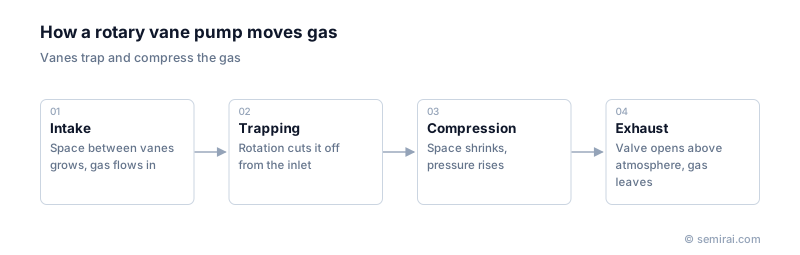
A rotary vane pump is a vacuum pump in which a rotor turning off-centre inside a cylinder, with vanes sliding in its slots, traps gas, compresses it and pushes it out. Oil seals the gaps and also lubricates and cools the pump, hence the name oil-sealed rotary pump. It can pump directly from atmospheric pressure and is simple and inexpensive.
Also called: rotary pump, oil rotary pump
Diagram
Performance and use
A single-stage pump reaches about 1 Pa, and a two-stage pump goes lower. For high vacuum, the rotary pump serves as a backing pump below a turbomolecular or oil diffusion pump.
Pumping gas that contains a lot of water vapour can let water condense into the oil and spoil performance. A gas ballast valve admits a little air during compression so the vapour is expelled before it condenses, at the cost of a slightly higher ultimate pressure.
Why fabs moved to dry pumps
On semiconductor process tools, rotary pumps have largely been replaced by dry pumps. Oil vapour can flow back towards the chamber (backstreaming) and contaminate it, and the corrosive gases and by-products of etching and CVD degrade the oil quickly.
Rotary pumps are still used where contamination and corrosive gases matter less, such as some load locks, analytical instruments and research equipment.
Japanese companies involved
- ULVAC makes oil-sealed rotary vacuum pumps, and Ebara makes the dry pumps that replaced them on most semiconductor process tools.
FAQ
How does a rotary pump differ from a dry pump?
A rotary pump uses oil to seal and lubricate the pumping chamber. A dry pump uses no oil where the gas passes; screw or Roots rotors turn without touching each other. Dry pumps avoid oil contamination and tolerate corrosive gases, so they are now standard on semiconductor process tools.
How should a rotary pump be maintained?
Check the oil level and colour regularly and change the oil when it darkens or becomes contaminated, since dirty oil raises the ultimate pressure. Run the gas ballast when pumping wet loads, and fit a trap or filter on the inlet side when backstreaming would harm the process.
Related pages
Sources
Last updated: November 1, 2026