Pumping Speed
Pumping speed is the volume of gas a vacuum pump can take in per unit time, expressed in litres per second (L/s) or cubic metres per hour (m³/h). If p is the pressure at the pump inlet and Q is the gas throughput, then S = Q/p. It is the basic figure used to compare the size and capacity of vacuum pumps.
Also called: effective pumping speed, volumetric flow rate
Diagram
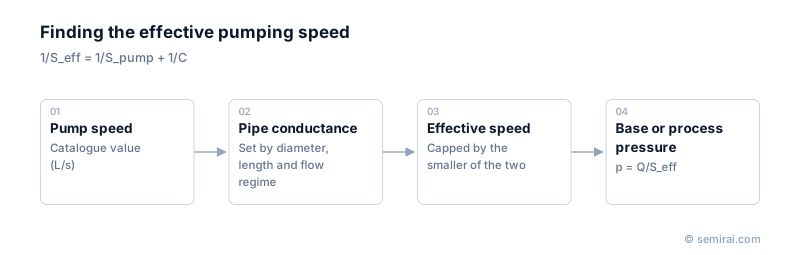
Effective pumping speed and conductance
How fast a chamber is actually pumped, the effective pumping speed, depends not only on the pump but on the conductance C of the pipe between them: 1/S_eff = 1/S_pump + 1/C. If the pipe conductance is small, the effective speed can never exceed it, however large the pump.
The effect is strongest in the molecular-flow regime of high vacuum, which is why high-vacuum pumps are mounted close to the chamber through a wide port.
Gas species and process pressure
Pumping speed changes with gas species and pressure. Turbomolecular pumps pump light gases such as hydrogen and helium relatively poorly, while cryopumps pump water vapour very fast.
The pressure a chamber reaches is set by the balance between pumping speed and the gas entering it, whether introduced process gas, outgassing from the walls or leaks. For tools that hold a constant pressure while gas flows, engineers estimate the required pumping speed from the gas flow and target pressure, then size the pump and piping to suit.
Japanese companies involved
- Ebara makes dry vacuum pumps widely used on semiconductor process tools.
- ULVAC makes a broad range of vacuum pumps, from roughing pumps and mechanical booster pumps to high-vacuum pumps.
FAQ
What is the difference between pumping speed and throughput?
Pumping speed is a volume per unit time at the inlet pressure, in L/s. Throughput is the quantity of gas actually flowing, expressed as pressure times volume per unit time, for example Pa·m³/s. Throughput equals pressure multiplied by pumping speed.
Why does a bigger pump not always pump faster?
If the conductance of the pipe between pump and chamber is small, the effective speed is capped by that conductance. Narrow or long pipes, bends and valves all reduce it, especially in high vacuum. Making the connection wider and shorter often helps more than buying a larger pump.
Related pages
Sources
Last updated: November 2, 2026