Roots Pump (Mechanical Booster Pump)
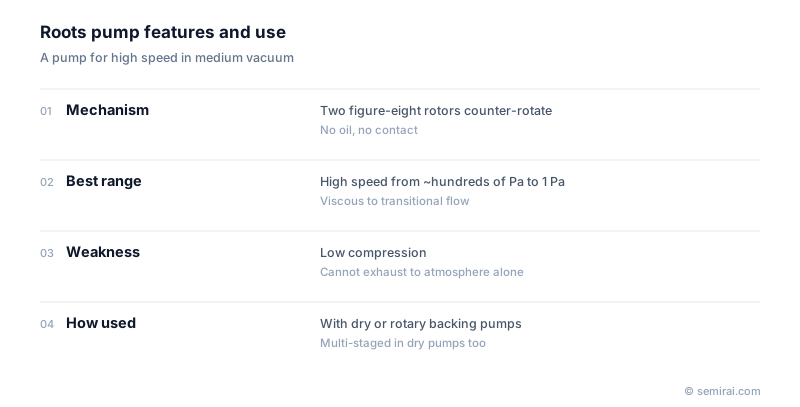
A Roots pump is a vacuum pump in which two rotors with a figure-eight cross-section turn rapidly in opposite directions with a small gap between them, carrying gas trapped between the rotors and the casing from inlet to outlet. It is also called a mechanical booster pump. No oil is used in the gas path, so contamination is low.
Also called: mechanical booster pump, Roots blower, booster pump
Diagram
Strengths and limits
A Roots pump delivers very high pumping speed in the medium-vacuum range, roughly from a few hundred pascals down to about 1 Pa. Its compression ratio is small, however, so on its own it cannot push gas out to atmospheric pressure.
It is therefore used with a backing pump, such as a dry pump or rotary pump, on its outlet side. The backing pump first lowers the pressure, then the Roots pump starts and multiplies the pumping speed.
Roots designs in semiconductor fabs
Many dry pumps used on semiconductor tools are multi-stage Roots pumps, with several pairs of Roots rotors in series inside one casing. Each stage compresses the gas a little until it reaches atmospheric pressure.
Processes such as dry etching and CVD flow large amounts of gas while holding a constant medium-vacuum pressure. For these, a Roots booster is often added on top of the dry pump to raise pumping speed.
Japanese companies involved
- ULVAC makes mechanical booster pumps, and Ebara makes multi-stage dry pumps used on semiconductor process tools.
FAQ
Why can a Roots pump not run on its own?
Small gaps between the rotors and the casing limit its compression ratio, so it cannot push gas out against atmospheric pressure. Running it at high inlet pressure also overheats it from compression heat. A backing pump on the outlet side keeps the pressure difference within its limits.
What is a multi-stage Roots dry pump?
It is a dry pump with several pairs of Roots rotors arranged in series, each compressing the gas a little until the last stage reaches atmospheric pressure. It pumps from atmosphere without oil and tolerates corrosive process gases, so it is widely used in semiconductor manufacturing.
Related pages
Sources
Last updated: November 2, 2026