Plating Additives
Plating additives are organic compounds added in small amounts to a copper electroplating bath to control how fast copper deposits at different locations, so that trenches and vias fill from the bottom up. They are essential for void-free and seam-free filling of damascene interconnects and through-silicon vias (TSVs).
Also called: accelerator, suppressor, leveller, copper electroplating additives
Diagram
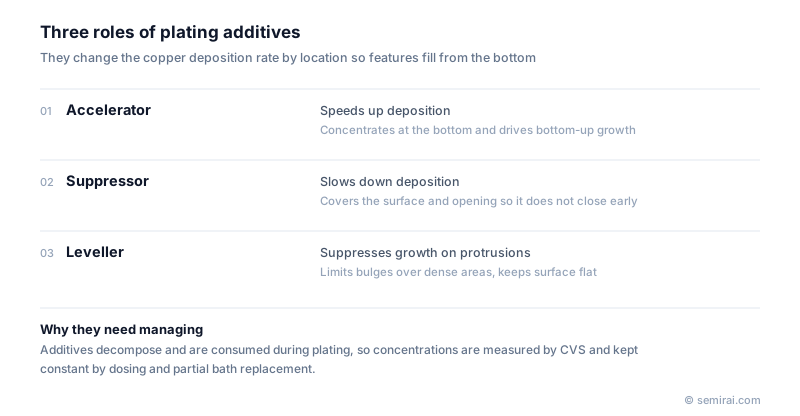
Three additives working together
An accelerator, typically a sulphur-containing compound such as SPS (bis(3-sulfopropyl) disulfide), speeds up copper deposition. A suppressor, a polymer such as polyethylene glycol working with chloride ions, adsorbs on the surface and slows deposition. A leveller, usually a nitrogen-containing compound, suppresses growth at protruding spots and keeps the surface flat.
Inside a feature, the copper surface area shrinks as the walls grow inward, so the adsorbed accelerator becomes concentrated at the bottom. Deposition there speeds up while the suppressor keeps the opening slow. The feature fills from the bottom before the opening closes, a behaviour called bottom-up fill or superfilling.
Managing the bath
Additives decompose and are consumed during plating, and their breakdown products build up. Their concentrations are therefore measured regularly, commonly by cyclic voltammetric stripping (CVS), and controlled by dosing and by bleeding and replacing part of the bath.
If breakdown products or additive fragments are incorporated into the copper, they can raise its resistivity and affect electromigration reliability and grain growth during annealing. Bath management therefore directly affects interconnect quality, not only the fill itself.
Japanese companies involved
- Ebara makes copper electroplating systems for wafer interconnects and advanced packaging, alongside its CMP equipment.
- Ebara · CMP systems, dry vacuum pumps and exhaust treatment
FAQ
What happens if the additive balance is wrong?
Too little accelerator or a weak suppressor lets the opening close before the bottom fills, trapping a void. Too little leveller lets copper bulge above dense arrays of fine lines, which leaves more copper for CMP to remove and can worsen dishing and erosion.
Are the same additives used for TSVs?
The same three-component principle is used, but TSVs are much larger and deeper than interconnect vias, so bath chemistries and current waveforms are tuned differently to fill them in a reasonable time without voids.
Related pages
Sources
Last updated: November 12, 2026