Replacement Metal Gate (RMG)
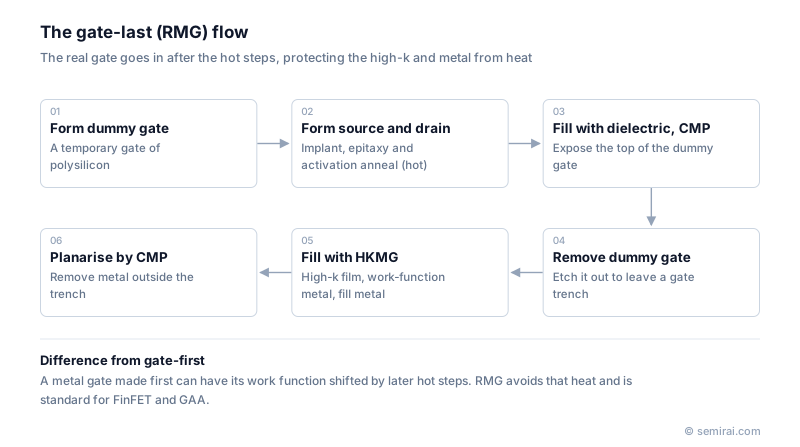
Replacement metal gate (RMG) is a gate-last process in which a dummy polysilicon gate is used while the source and drain are formed and annealed, then removed and replaced with a high-k dielectric and metal gate stack. It is the standard way to build gates in FinFET and gate-all-around logic.
Also called: RMG, gate-last process
Diagram
Why the gate is formed last
Activating the source and drain dopants needs anneals that can exceed 1000°C. If the metal gate is already in place, as in a gate-first flow, such heat can shift its work function and move the transistor's threshold voltage away from the design value. RMG avoids this by building the real gate only after the hottest steps are finished, which also widens the choice of work-function metals.
Process flow
A typical flow runs as follows. A dummy gate of polysilicon over thin oxide is patterned, with spacers on its sides. The source and drain are formed, often by epitaxial growth, and annealed. The wafer is covered with an interlayer dielectric and planarised by chemical mechanical polishing (CMP) until the top of the dummy gate is exposed. The polysilicon is selectively etched away, leaving a gate trench.
Inside the trench an interfacial oxide layer is formed, HfO₂ is deposited by atomic layer deposition, and one or more work-function metals follow. A low-resistance fill metal such as tungsten completes the electrode, and a final CMP removes metal outside the trench.
What changes with gate-all-around
In nanosheet transistors the removed volume includes the gaps between stacked silicon sheets, which are only several nanometres high. Every layer of the gate stack must reach the lowest sheet with uniform thickness, and the fill must be free of voids. Additional steps such as inner spacers and gate cut, which separates gates of neighbouring devices, make the RMG module considerably more complex than in FinFETs.
Japanese companies involved
- Tokyo Electron supplies etch, deposition and cleaning equipment used in steps such as dummy gate removal and gate-stack deposition.
- Tokyo Electron (TEL) · Coat/develop, etch and deposition equipment
FAQ
What are the drawbacks of RMG?
It adds steps that a gate-first flow does not need: an extra dielectric fill, two CMP steps, selective removal of the dummy gate and deposition into a narrow trench. Each step adds cost and potential defects, such as residues left in the trench or dishing during metal CMP.
Is the high-k layer always deposited after the dummy gate is removed?
Not always. In a high-k-first, metal-gate-last variant the high-k layer is deposited under the dummy gate and only the metal is replaced. In a high-k-last flow both are deposited into the trench, which protects the high-k film from the thermal budget as well.
Related pages
Sources
Last updated: November 2, 2026