Precursor
A precursor is the source compound used to deposit a thin film by chemical vapour deposition (CVD) or atomic layer deposition (ALD). It contains the element to be deposited, such as silicon, hafnium, tungsten or cobalt, and is delivered as a vapour to the chamber, where heat, plasma or a second gas makes it react and leave a film.
Also called: CVD precursor, ALD precursor, source material
Diagram
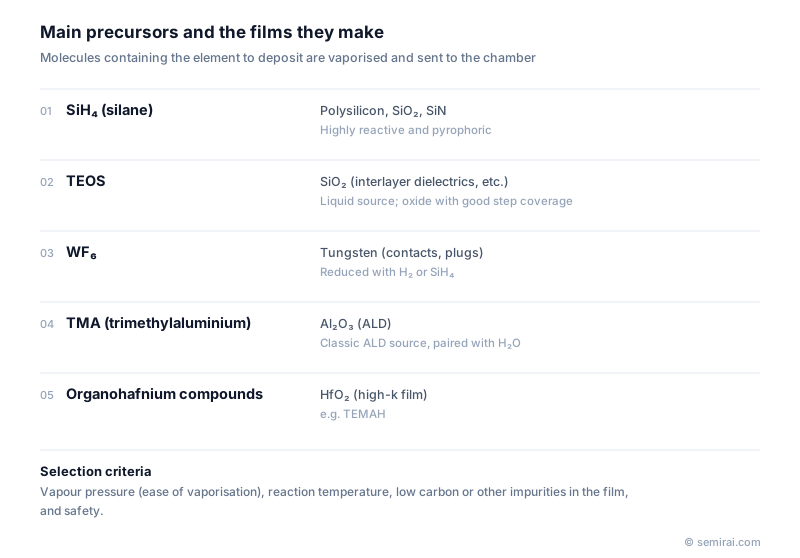
Typical precursors
Most precursors bind the target element to ligands that make the molecule volatile. Silane (SiH₄) and organosilicon compounds such as TEOS are used for silicon, silicon oxide and silicon nitride. Tungsten hexafluoride (WF₆) is used for tungsten plugs, trimethylaluminium (TMA) for ALD aluminium oxide, and organohafnium compounds such as TEMAH or the chloride HfCl₄ for hafnium oxide high-k films.
A good precursor has a vapour pressure high enough for stable delivery, reacts in the intended temperature window, leaves little carbon, chlorine or other impurity in the film, stays stable in storage, and can be purified to very high levels. The precursor choice largely sets the deposition temperature and, in ALD, how uniformly a film coats deep features.
Delivery and safety
Many precursors are liquids or solids at room temperature. Liquids are delivered by bubbling an inert carrier gas through a heated container, or by metering the liquid into a vaporiser. Solids are sublimed. Gas lines are heated so the vapour does not condense on the way to the chamber.
Some precursors are toxic or pyrophoric, igniting on contact with air; silane and TMA are well-known examples. Handling requires sealed cylinders or canisters, gas cabinets with leak detection, and abatement systems that treat the exhaust. As devices become three-dimensional, development continues on precursors that react at lower temperatures and coat deep structures uniformly.
Japanese companies involved
- Japanese chemical makers such as ADEKA and Tosoh develop and supply CVD and ALD precursors, including materials for high-k and other advanced films.
- Tosoh · Sputtering targets, ALD/CVD precursors and quartz glass
- Kokusai Electric · Batch deposition, diffusion and ALD equipment
FAQ
What is a metal-organic precursor?
It is a precursor in which a metal atom is bonded to organic ligands, such as amides, alkyls or cyclopentadienyl groups. The ligands make the molecule volatile and tune its reactivity. Their main risk is leaving carbon or nitrogen in the film if the ligands do not leave cleanly.
Why are some films made with halide precursors instead?
Halides such as WF₆, TiCl₄ and HfCl₄ are thermally robust and contain no carbon, so they give pure films and wide process windows. Their drawbacks are corrosive by-products such as HF or HCl and possible chlorine or fluorine left in the film.
Related pages
Sources
Last updated: November 12, 2026