Spin-On Glass (SOG)
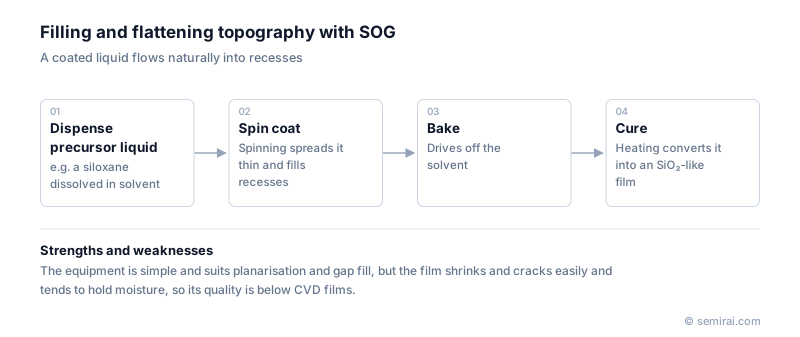
Spin-on glass (SOG) is a liquid containing a dissolved silicon oxide precursor that is dispensed onto a wafer, spread into a thin uniform layer by spinning, and then baked and cured into an SiO₂-like film. Because it is applied as a liquid, it flows into gaps and smooths out steps.
Also called: SOG, spin-on dielectric, SOD
Diagram
Materials and process
SOG materials fall into inorganic silicate types and siloxane types that contain organic groups. More broadly, spin-on dielectrics (SOD) include other coated insulators such as polysilazane-based films that convert to oxide.
The process uses the same kind of coating equipment as photoresist. The liquid is dispensed and spun, a bake drives off the solvent, and a higher-temperature cure converts the film into a glassy oxide. Where chemical vapour deposition builds a film up from the gas phase, SOG uses the flow of a liquid to fill narrow spaces.
Where SOG is used
Its classic use was planarising the dielectric between interconnect layers before chemical mechanical polishing became common. SOG-type materials have also been used to fill the narrow trenches of shallow trench isolation (STI) and other high-aspect-ratio gaps, and in MEMS and mature-node processes.
The key quality issues are shrinkage and cracking during cure, outgassing, and residual moisture. Organic-containing SOG cracks less but is harder to etch and can release gases later in the process. The coated-dielectric approach continued in spin-on low-k films for interconnects.
Japanese companies involved
- Tokyo Ohka Kogyo (TOK) and JSR, both major photoresist makers, have supplied spin-on glass and other coated dielectric materials.
- Tokyo Ohka Kogyo (TOK) · Photoresists and high-purity process chemicals
- JSR · Photoresists and semiconductor materials
FAQ
How do SOG and CVD oxide work together?
A common historical scheme was a sandwich: a CVD oxide liner, SOG to fill the low areas and smooth the surface, and another CVD oxide on top. The dense CVD layers provide insulation and reliability while the SOG provides planarity.
What are the weaknesses of SOG?
The film shrinks as solvent leaves and the network condenses, so thick layers crack. It can retain water and hydroxyl groups, which may corrode metal wiring or degrade devices later. For these reasons SOG is used in thin layers or with careful curing.
Is SOG still used?
Planarisation in advanced logic has moved to CMP, but coated dielectrics are still used for gap fill, in MEMS and in some mature-node steps. Flowable CVD was developed partly to bring the liquid-like filling behaviour of SOG into a vacuum deposition process.
Related pages
Sources
Last updated: November 2, 2026